Flagstaff, AZ USA

Buddhism, Vegetarianism, and Qi Gong: How Buddhist Diets Shaped East Asian Qi Gong Traditions

Buddhism, Vegetarianism, and Qi Gong explores how Buddhist temple diets shaped monastic qi gong practices—and how Shaolin, Taoist, Confucian, and folk diets diverged. This deep dive includes a qi-friendly temple soup recipe to help modern practitioners connect tradition with daily practice.
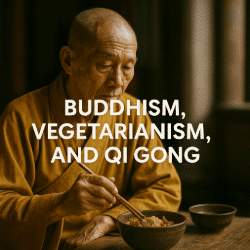
A Buddhist monk in golden robes sitting at a wooden table, holding chopsticks and preparing to eat a simple vegetarian meal, reflecting the dietary influence on qi gong practice.

Introduction

If you look at East Asian energy practices—qi gong, dao yin, breath-work—you quickly discover that they didn’t grow in a single garden. Some lineages grew in Buddhist monasteries. Some grew in Taoist hermitages. Some grew in Confucian households or in the hands of rural martial families.

But food?
Food shaped all of them.

Buddhist vegetarianism influenced the rhythm of monastic qi gong.
Taoist dietary principles shaped internal alchemy and seasonal health.
Folk practitioners followed practical, omnivorous diets that fueled heavy labor.

To understand qi gong, you have to understand the stomach behind it.

Why Buddhist Diets Became So Strongly Linked to Qi Gong

Early Indian Buddhism didn’t demand vegetarianism, but by the time Buddhism settled into East Asia—especially China—monastic codes emphasized compassion toward animals and internal calm. Texts like the Lankavatara Sutra argued that eating animals agitated the mind and obstructed meditation.

Whether or not you accept the theology, you can’t deny the physiology:
heavy, greasy meals make sitting still miserable.

Monastic vegetarian diets became the perfect companion to breathing practices. They:

  • reduced digestive load,

  • stabilized mood,

  • reduced inflammatory discomfort,

  • and supported deep abdominal breathing.

Modern research supports pieces of this. Plant-forward diets can reduce systemic inflammation and improve emotional regulation—two things meditators noticed a thousand years ago (Barnard 2019; Kahleova 2021).

But here’s where the history gets interesting…

The Shaolin Exception: Yes, They Ate Meat—and Yes, It Caused Tension

Although Chan Buddhism is widely associated with vegetarianism, Shaolin Monastery was not strictly vegetarian throughout its history.

Why Shaolin Ate Meat

Shaolin developed a unique identity as a “martial” monastery. Its monks served as escorts, guards, and occasionally state-recognized fighters. Several historical records note:

  • Tang- and Song-dynasty documents referencing armed monks

  • Ming-dynasty gazetteers describing Shaolin monks who “ate meat and drank wine” during martial duties

  • Evidence compiled by historian Meir Shahar that Shaolin cuisine included meat during certain periods

Meat wasn’t a luxury—it was fuel for physically demanding training and temple defense.

Buddhist Community Backlash

This exception absolutely caused conflict:

  • Vinaya-abiding monks saw it as a moral breach

  • Pure Land communities criticized Shaolin for being too worldly

  • Confucian literati pointed to Shaolin as an example of undisciplined monasticism

In short:
Buddhist influence on qi gong was real, but it was never monolithic.

Shaolin is the clearest example of a Buddhist institution shaping qi gong without adopting full vegetarianism.

What Buddhist Vegetarianism Contributed to Qi Gong

Where vegetarianism did dominate, it shaped the style of qi gong practiced in monasteries.

1. Breath Freedom

Vegetable-rich, low-fat meals made diaphragmatic breathing easier.
Heavy meats create abdominal fullness that makes deep breathing—especially reverse breathing—more uncomfortable.

2. Clearer Mind and Shen

Monastic cuisine like lotus root, barley porridge, tofu, and leafy greens was chosen because it kept the mind calm for long meditation.

3. Endurance and Repetition

Temple qi gong often required:

  • sustained repetition

  • long holds

  • stable breath rhythms

Lighter diets supported these patterns.

But this is only one voice in the larger qi gong chorus.

The Other Side: Taoist and Folk Qi Gong Were Not Vegetarian

If we stop the story here, we risk giving the impression that energy practice equals vegetarianism.

That’s historically wrong.

Taoist Diets: Light for Practice, Not Plant-Only

Taoist dietary traditions fall into several categories:

1. Internal Alchemy Practitioners

Used “lightening” diets to support meditation:

  • simple grains

  • vegetables

  • minimal spices

  • gentle broths
    But meat was allowed in moderate portions. Taoist texts rarely prohibit animal foods outright.

2. Ritual Taoists

Some sects practiced vegetarianism for:

  • purification periods

  • rituals

  • fasting retreats

Outside those windows, diets returned to normal.

3. Folk Taoists and Martial Lineages

These groups ate regional, practical diets—usually omnivorous:

  • pork and poultry in northern regions

  • fish in coastal areas

  • beef where available

  • hearty stews and congee for labor-intensive lifestyles

Qi cultivation was tied to seasonal alignment, not abstention.

Confucian Dietary Philosophy Was Also Meat-Inclusive

Confucianism emphasized:

  • moderation

  • harmony

  • ritual appropriateness

Meat was part of proper household management and ancestral offerings.
A Confucian practitioner doing qi-based breathing wouldn’t remove meat unless for personal health.

This matters because many qi gong routines were developed by Confucian scholars and physician-practitioners, not monks.

Folk Qi Gong: The Most Omnivorous of All

Many of the most practical, body-first qi gong traditions came from villagers, soldiers, farmers, and martial artists. Their diets prioritized:

  • strength

  • recovery

  • warmth in winter

  • affordability

These practitioners often ate the heaviest foods:

  • meat broths

  • organ meats

  • eggs

  • fish

  • seasonal vegetables

  • rice and millet

Qi gong in these settings was never paired with ethical vegetarianism.

So How Did Buddhist Diets Actually Influence Qi Gong?

The key is institutional influence:

  • Qi gong created in Buddhist temples tended to assume a plant-based environment.

  • Qi gong created in Taoist, folk, or martial settings assumed omnivorous diets.

  • Shaolin sits at the crossroads: Buddhist in structure, martial in function, flexible in diet.

This explains why some qi gong schools feel “light and meditative” while others feel “grounded and muscular.”

Different stomachs created different bodies.
Different bodies created different practices.

What Should Modern Practitioners Take From This?

If you lean Buddhist or meditative:

A lighter, plant-forward diet supports:

  • calm breathing

  • improved focus

  • reduced inflammatory discomfort

  • better sitting practice

If you lean Taoist or martial:

An omnivorous but moderate diet often supports:

  • strength

  • seasonal alignment

  • recovery

  • sustained training

The middle path (which most modern athletes follow):

Mostly plant-based foods, with optional lean proteins (fish, poultry, tofu, legumes) and minimal heavy red meat before qi gong sessions.

This honors the spirit of the traditions without over-romanticizing them.

Sources:

  • Lankavatara Sutra – teachings on mind clarity and compassion

  • Tang and Ming historical records on Shaolin dietary practice

  • Meir Shahar, The Shaolin Monastery (Princeton University Press)

  • Huangdi Neijing – digestive load and qi transformation

  • Research on plant-based diets and inflammation (Barnard 2019; Duggal 2018)

  • Studies on vegetarian diets and endurance/mood (Craddock 2019; Kahleova 2021)

  • Ethnographic work on shōjin ryōri and Korean temple cuisine

  • Taoist internal alchemy dietary manuals (Qing/Song commentaries)

Carry your practice beyond the mat.

The Refined Qi Gong Collection blends stillness and style — inspired by the same principles you train with.

Explore the Collection →

ADDENDUM: A Qi-Friendly Buddhist Temple Recipe

Lotus Root & Ginger Monk’s Broth (Qi-Clearing Temple Soup)

A gentle, grounding vegetarian dish used in Buddhist temples across China and Japan to settle the stomach and open the breath before training or meditation.

This recipe reflects the elements that shaped monastic qi gong diets:

  • light digestion,

  • stable energy,

  • anti-inflammatory roots and mushrooms,

  • and a clear, calming broth.

It’s easy to cook, easy to digest, and perfect before qi gong or meditation.

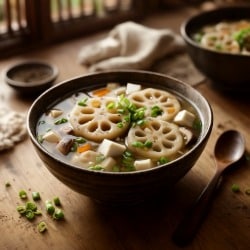
A bowl of lotus root and ginger soup with tofu, shiitake mushrooms, and scallions in a rustic ceramic bowl on a wooden table, representing a traditional Buddhist temple-style recipe.

Lotus Root & Ginger Monk’s Broth

Serves: 2–3
Time: 20–25 minutes
Difficulty: Extremely easy

Ingredients

  • 1 cup sliced lotus root

  • 1 cup shiitake mushrooms, fresh or rehydrated

  • 1 small carrot, thinly sliced

  • 1-inch piece fresh ginger, sliced

  • 1 block silken or soft tofu, cubed

  • 4 cups vegetable broth or light mushroom broth

  • 1 tsp soy sauce or tamari (optional)

  • 1 tbsp scallions, finely sliced

  • A sprinkle of white pepper (optional)

Instructions

  1. In a medium pot, bring the vegetable broth to a gentle simmer.

  2. Add the sliced lotus root, carrot, ginger, and mushrooms.

  3. Simmer for 10–12 minutes until the lotus root is tender but still crisp.

  4. Add tofu and cook another 3–4 minutes.

  5. Season with soy sauce and white pepper as desired.

  6. Ladle into bowls and top with scallions.

Why This Works for Qi

  • Lotus root helps clear heat and stabilize energy in traditional East Asian cooking.

  • Ginger warms the stomach and supports smooth qi flow.

  • Mushrooms provide grounding, umami-rich nourishment without heaviness.

  • Tofu adds protein without digestive drag.

This is the closest thing to a “universal” qi gong-friendly soup found across Buddhist temples — gentle, nourishing, and calming to both breath and mood.

Lotus Root & Ginger Monk’s Broth (Qi-Clearing Temple Soup)

Servings: 2–3
Time: 20–25 minutes

Ingredients

  • 1 cup sliced lotus root
  • 1 cup shiitake mushrooms
  • 1 small carrot, sliced
  • 1-inch fresh ginger, sliced
  • 1 block silken tofu, cubed
  • 4 cups vegetable or mushroom broth
  • 1 tsp soy sauce (optional)
  • 1 tbsp scallions, sliced
  • White pepper to taste (optional)

Instructions

  1. Simmer the broth gently in a medium pot.
  2. Add lotus root, carrot, ginger, and mushrooms. Cook 10–12 minutes.
  3. Add tofu and cook 3–4 minutes more.
  4. Season with soy sauce or pepper.
  5. Serve topped with scallions.

Frequently Asked Questions

Did all Buddhist monks follow vegetarian diets?

No. While many Buddhist monasteries embraced vegetarianism, Shaolin had historical exceptions that allowed meat consumption, especially during periods of martial training or temple defense.

Were Taoist and folk qi gong diets also vegetarian?

No. Taoist, Confucian, and folk martial lineages were generally omnivorous. Their dietary focus was on moderation, seasonal alignment, and digestive ease—not ethical vegetarianism.

What kind of foods best support qi gong practice?

Light, easy-to-digest meals—such as vegetables, mushrooms, tofu, congee, or mild soups—support smooth breathing. Lean proteins or traditional broths may also work well depending on your lineage or training intensity.

Why include a Buddhist temple recipe in this article?

Buddhist monastic cuisine strongly shaped certain qi gong traditions. The recipe helps readers experience the dietary foundation that supported monastic breathing and meditation practices.

Can I practice qi gong after eating?

Yes, but it’s best to wait 30–60 minutes after a meal. Qi gong can feel uncomfortable on a full stomach, especially after heavy foods.

Leave a Reply