Flagstaff, AZ USA

Qi Gong and Confucian Moderation: The Art of Balance in Practice and Life

Explore how the ancient principle of balance guides modern nutrition and energy practice for long-term vitality. Discusses representative diets that promote moderation and proper qi.
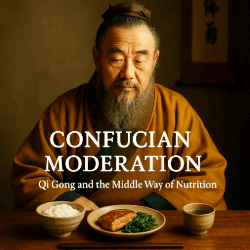
Cinematic image of an elderly Confucian scholar seated at a wooden table with a modest meal of rice, braised duck, and greens, softly lit in warm tones. Text overlay reads “Confucian Moderation: Qi Gong and the Middle Way of Nutrition.”

When you study qi gong long enough, you start to notice that the practice is less about technique and more about proportion—how much effort, how much rest, how much you eat, and how you meet the world. That sense of proportion has deep cultural roots.

Long before qi gong became a global wellness trend, the Confucian idea of moderation—the “Doctrine of the Mean” (Zhong Yong, 中庸)—was shaping how people in China thought about health, conduct, and even food.

This article explores how Confucian moderation and qi gong overlap, and why the meeting point of philosophy and physiology still matters for anyone training the body-mind connection today.

The Confucian Foundation: Balance Without Extremes

Confucius didn’t speak directly of qi gong, but he lived in a world where qi (vital energy) and harmony were the language of daily life. In his teaching, virtue wasn’t about excess. It was about finding the center—the calm point between indulgence and denial.

The Zhong Yong describes moderation as “the constant virtue of Heaven and Earth.” To live moderately is to move in rhythm with natural cycles, not to force them. In early Chinese society, that meant clear rituals, measured behavior, and a diet that reflected both season and circumstance.

This moral framework shaped medicine and martial practice alike. By the time qi gong systems matured in the Han and Tang dynasties, Confucian ideals had already filtered into the foundations of Traditional Chinese Medicine (TCM) and daily conduct—teaching practitioners that inner peace wasn’t found in extremes but in steady, sustained practice.

Moderation in the Body: The Qi Gong Parallel

Qi gong translates literally to “energy work,” but its true goal is regulation—of breath, posture, and emotion. Push too hard, and the qi becomes scattered. Hold too tight, and it stagnates.

The Confucian student who learned temperance in speech and desire was already practicing the same principle a qi gong adept learns in movement: no excess, no deficiency.

  • Effort: Train consistently, not obsessively.

  • Diet: Eat until satisfied, not stuffed.

  • Emotion: Express without domination; remain centered in conflict.

  • Rest: Recovery is part of discipline.

Moderation doesn’t dull the edge—it keeps the blade from cracking.

Food as a Mirror of Virtue

Confucian texts often linked good manners to good digestion. Meals were ritual moments—taken at proper times, in correct measure, with awareness of others. To gorge or neglect eating entirely was a sign of imbalance, not refinement.

Later physicians echoed this moral physiology. The Tang dynasty physician Sun Simiao—often called the King of Medicine—wrote that “to govern the body, one must first moderate desires and diet” (Qianjin Yaofang, ca. 652 CE). The message was consistent across centuries: the stomach is not just a vessel for food; it’s the seat of intention.

In qi gong terms, the spleen and stomach form the body’s central energy system, transforming food into usable qi. Overburden them, and energy weakens; undernourish them, and vitality wanes. Moderation keeps this inner furnace steady.

Eating the Middle Way: A Confucian–Qi Gong Diet in Practice

If Confucian moderation had a meal plan, it wouldn’t be a list of superfoods or a 7-day cleanse. It would look more like a rhythm—steady, seasonal, and proportionate. The goal is not restriction or indulgence, but balance that keeps qi circulating and digestion calm.

Below are practical principles and examples drawn from both qi gong tradition and modern nutritional science.

Eat in Proportion, Not Perfection

In Confucian language, excess is chaos. Modern research agrees: metabolic health declines not from one “bad” food, but from consistent imbalance in portions and energy intake.
A balanced plate mirrors both TCM and WHO guidance for longevity-focused diets (World Health Organization, 2020).

Guideline:

  • ½ vegetables and fruits (mostly cooked or lightly steamed)

  • ¼ whole grains or starchy roots (rice, millet, oats, sweet potatoes)

  • ¼ proteins (tofu, tempeh, fish, eggs, or lean meats if tolerated)

This ratio keeps digestion centered in the “middle burner,” the energetic core of qi transformation.

Respect the Seasons

Confucian thought views humans as part of nature’s moral order. Qi gong expresses that physically: your metabolism rises and falls with temperature and daylight.

SeasonKey FoodsPurpose
SpringGreens, sprouts, light grainsMove stagnant winter energy
SummerHydrating fruits, cucumber, mung beans, herbal teasDispel heat and replenish fluids
AutumnRoots, squash, pears, moderate spiceSupport lungs and immunity
WinterBroths, stews, black sesame, oatsNourish and warm kidney qi

Seasonal eating has been shown to improve gut microbiome diversity and reduce inflammation (Zheng et al., Frontiers in Nutrition, 2022).

Balance Warmth and Coolness

When digestion feels sluggish, use warming foods (ginger, cinnamon, cooked grains). When inflamed or overheated, choose cooling foods (greens, mung bean soup, chrysanthemum tea).

Sample Balanced Day:

  • Breakfast: Warm oatmeal with nuts, dates, and a hint of ginger.

  • Lunch: Stir-fried vegetables with tofu and brown rice.

  • Dinner: Miso soup, steamed greens, and baked sweet potato.

  • Snacks: Seasonal fruit or roasted seeds.

This approach supports stable blood glucose and smooth digestion—consistent with findings from the Harvard T.H. Chan School of Public Health on moderate glycemic balance (Hu, 2022).

Moderate Stimulants and Stress Foods

Coffee, alcohol, and heavily processed oils disrupt qi and recovery. Confucian restraint recommends occasional use, never daily dependence.

Modern parallels:
The NIH recommends limiting alcohol to ≤1 drink/day for women and ≤2 for men (NIH, 2021). Caffeine intake above 400 mg/day is linked to sleep disruption and stress hormone elevation (Clark & Landolt, Nutrients, 2017).

Eat With Awareness

In both traditions, how you eat matters as much as what you eat.

  • Sit down—don’t eat while standing or scrolling.

  • Start meals with a calm breath.

  • Stop at 70–80% fullness, a principle known in Japan as hara hachi bu, also associated with reduced mortality (Willcox et al., Ageing Research Reviews, 2014).

Modern Nutrition Meets Confucian Wisdom

Mindful, moderate eating now has measurable benefits: improved digestion, insulin regulation, and emotional stability (Harvard Medical School, 2023).
Both qi gong and Confucian moderation aim at what modern physiology calls homeostasis—the body’s natural equilibrium.

Harmony between thought, breath, and biology isn’t mystical; it’s metabolic.

Final Thoughts

Confucian moderation reminds us that mastery isn’t about pushing boundaries—it’s about knowing when not to. Qi gong gives that philosophy form through breath and movement. Together, they create a framework for health that’s both ethical and practical: cultivate energy, avoid extremes, and respect the natural rhythm of life.

In an age of overconsumption and overtraining, moderation may be the most radical discipline of all.

References

  1. Zhong Yong (Doctrine of the Mean), 5th c. BCE, in The Four Books.

  2. Sun Simiao, Qianjin Yaofang (Prescriptions Worth a Thousand Gold), ca. 652 CE.

  3. World Health Organization. “Healthy diet.” Updated 2020.

  4. Zheng, J. et al. “Seasonal dietary variation and gut microbiota.” Frontiers in Nutrition 9:832882, 2022.

  5. Hu, F. B. “Dietary patterns and health outcomes.” Harvard T.H. Chan School of Public Health, 2022.

  6. Clark, I., & Landolt, H. P. “Coffee, caffeine, and sleep: A systematic review.” Nutrients 9(10): 1199, 2017.

  7. Willcox, D. C. et al. “Caloric restriction and longevity in Okinawa.” Ageing Research Reviews 13: 68–74, 2014.

  8. National Institutes of Health. “Dietary Guidelines for Americans 2020–2025.”

  9. Harvard Health Publishing. “The benefits of mindful eating.” Updated 2023.

Qi Gong & Confucian Moderation – FAQ

What does Confucian moderation mean in daily life?

Confucian moderation, described in the Zhong Yong (Doctrine of the Mean), is about living in balance—avoiding excess and deficiency. In practice, it means acting, eating, and speaking with measured purpose.

How does Confucian philosophy connect to Qi Gong?

Both systems emphasize harmony and regulation. Qi Gong expresses moderation through balanced breath, posture, and energy flow—the physical counterpart to Confucian mental and moral balance.

What kind of diet supports Confucian moderation?

A diet based on whole foods, seasonal ingredients, and portion balance reflects Confucian ideals. Think rice, vegetables, moderate protein, and tea—meals that nourish without excess or deprivation.

Is meat allowed in a moderate Qi Gong diet?

Yes, in moderation. Historically, poultry and fish were acceptable sources of qi-nourishing protein, eaten sparingly and respectfully within balanced meals.

How can modern science support this philosophy?

Studies on mindful eating, circadian nutrition, and moderate caloric intake confirm the benefits of balance—improved digestion, metabolism, and emotional health—all central to Confucian and Qi Gong teachings.

What’s a simple way to practice moderation today?

Start with awareness: eat slowly, stop at 80% fullness, limit processed foods, and balance activity with rest. This aligns ancient wisdom with modern health practices.

Medical Disclaimer

This content is for educational purposes and not a substitute for personalized medical advice. Consult a qualified health professional for dietary or medical concerns.
Leave a Reply