Taoist Diets and Qi Gong
Fasting, Grain Avoidance (Bigu), and Food-as-Medicine in Early Taoism. Explore how ancient Taoist dietary practices connect with modern Qi Gong and nutritional science to balance energy, body, and mind.
Flagstaff, AZ USA
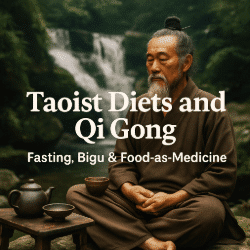
From mountain hermits to modern wellness seekers, Taoist dietary practice has always been more than a matter of eating right—it’s been a matter of alignment. The earliest Taoists viewed food as one of the central pathways to balance the body’s qi (vital energy), preserve life, and refine the spirit.
Today, these ideas are finding new life in Qi Gong and holistic nutrition circles. Whether you’re fasting for clarity, avoiding inflammatory foods, or simply trying to eat in rhythm with your training, Taoist principles can provide both philosophical grounding and practical guidance.
In Taoist cosmology, food is condensed qi. Every grain, root, and fruit carries the energy of heaven and earth. To eat well is not just to nourish the body but to maintain the natural flow of qi through the organ systems.
Early Taoist texts like the Huainanzi and Zhuangzi describe sages who “ate the breath of the wind” and lived in tune with the cosmos. While such imagery sounds mystical, it reflects an important principle: food is only one form of nourishment. Breath, sunlight, rest, and stillness also feed life.
Modern Qi Gong practitioners interpret this as a call to simplify—eating in a way that supports rather than overwhelms the internal flow. The more refined the qi, the lighter and cleaner the diet.
Fasting (zhai 齋 or duan shi 斷食) was not a punishment in Taoist tradition—it was a tool. Practitioners fasted before meditation, ritual, or Qi Gong practice to clear the senses and sharpen energy flow.
Historically, there were three major forms of fasting:
Periodic fasting: short abstentions from solid food before major ceremonies or retreats.
Purification fasting: reduction of heavy or pungent foods (meat, garlic, onion, leeks) to refine qi and avoid over-stimulation of the internal fire.
Prolonged fasting: extended abstention to purge toxins and cultivate spiritual energy, often supervised by a teacher.
Modern physiology supports many of these benefits. Studies show that intermittent fasting can reduce systemic inflammation, improve insulin sensitivity, and promote cellular repair through autophagy (Longo & Panda, Cell Metabolism, 2016).
For Qi Gong practitioners, the aim is not to deplete but to lighten—allowing the breath and movement to take over the work of digestion, giving the organs time to recover.
One of the most misunderstood Taoist dietary traditions is bigu (避穀), literally “avoiding grains.” Ancient texts described immortals who ceased eating grains entirely, subsisting on herbs, fruits, and the essence of the cosmos.
Scholars interpret bigu in three overlapping ways:
Physiological: A means of detoxification and stabilizing the gut; ancient grain diets were often fermenting or parasite-prone.
Energetic: Grains were considered “turbid” and heavy, binding qi to the lower body. Avoiding them encouraged upward energy flow and mental clarity.
Symbolic: A break from the agricultural cycle of society, representing independence from worldly attachments.
Modern interpretations of bigu resemble modified fasting or ketogenic diets. Some Qi Gong teachers recommend short-term grain avoidance to “reset” the digestive system and recalibrate energy sensitivity.
However, complete long-term grain avoidance can be risky without medical supervision. Taoism traditionally emphasized balance and adaptation, not rigid rules. As the Tao Te Ching says, “He who stands on tiptoe cannot stand firm.”
The Taoist medical view, later refined in Chinese medicine, saw food as the first line of healing. The concept of shi liao (食療)—food therapy—was built on the same energetic framework used in acupuncture and herbalism.
Foods were classified by flavor, temperature, and organ correspondence:
| Flavor | Organ | Function | Example |
|---|---|---|---|
| Sour | Liver | Astringes and preserves fluids | Lemon, hawthorn |
| Bitter | Heart | Clears heat | Bitter melon, cacao |
| Sweet | Spleen | Tonifies and harmonizes | Rice, sweet potato |
| Pungent | Lungs | Disperses stagnation | Ginger, scallion |
| Salty | Kidneys | Softens hardness, draws inward | Seaweed, miso |
In Qi Gong terms, these categories mirror how different movements or breathing patterns affect the same organ networks. When the diet supports the energetic training, the result is smoother practice and faster recovery.
For example, after a session of vigorous Fa Jin or dynamic Qi Gong, eating cooling, yin foods like cucumber or pear tea can help the body settle. During cold months or periods of weakness, warming foods like bone broth, ginger, and millet porridge help restore yang energy.
Modern nutrition echoes many of these classical insights. The Taoist emphasis on moderation, seasonal eating, and natural ingredients aligns closely with modern anti-inflammatory diets.
A practical approach for today’s practitioner might look like:
Morning: Warm water with lemon or ginger to awaken digestion.
Midday: Balanced meal emphasizing whole vegetables, moderate protein, and complex carbohydrates.
Evening: Lighter, easily digestible foods—soups, congee, or steamed greens.
Weekly: One fasting or light day, using Qi Gong or meditation to ease hunger and regulate energy.
Rather than fixating on rigid purity, the Taoist approach invites ongoing dialogue between the body and the world. If a food harmonizes with your breath, strength, and spirit, it’s the right food. If it creates heaviness or agitation, no scripture is needed to tell you otherwise.
Qi Gong is, in essence, the body learning to feed on breath and awareness as much as on food. Over time, practitioners notice their appetite, taste, and tolerance shift. Heavier foods may feel obstructive; lighter, cleaner fare becomes appealing.
Here’s a modern Taoist rhythm you might explore:
Eat when hungry, stop before full. Leave 20% of the stomach empty for qi to move.
Fast occasionally. Not to punish, but to remember that nourishment has many forms.
Eat locally and seasonally. Nature already balances yin and yang through the calendar.
Respect food. As one classic saying puts it: “To waste food is to waste life-force.”
Such habits strengthen digestive qi and enhance the sensitivity necessary for deep Qi Gong training.
Taoist dietary wisdom doesn’t demand ascetic purity. It teaches responsiveness—knowing when to hold, when to release, when to cleanse, and when to nourish.
As modern science continues to confirm the benefits of fasting, mindful eating, and plant-forward diets, the old mountain sages seem less mysterious. They were simply following the body’s natural intelligence, guided by the Tao.

Designed for practitioners — wearables, journals, and keepsakes shaped by stillness.
Explore the Refined Qi Gong Collection →Huainanzi (c. 2nd century BCE)
Zhuangzi (c. 4th century BCE)
Longo, V. D., & Panda, S. (2016). Fasting, circadian rhythms, and time-restricted feeding in healthy lifespan. Cell Metabolism, 23(6).
Kohn, Livia (1993). The Taoist Experience: An Anthology.
Engelhardt, Ute (2001). “Longevity Techniques and Taoist Dietetics.” Journal of Chinese Medicine and Philosophy.
National Center for Complementary and Integrative Health (NCCIH): Fasting and Health: What the Science Says (2023).
Bigu (避穀) means “avoiding grains.” In early Taoism it referred to abstaining from cereals to purify the body and refine qi. Practitioners believed that heavy or fermented grains created turbid energy. Today, Bigu is often interpreted as short-term fasting or simplified eating to reset digestion and increase energy awareness.
Fasting helped Taoist practitioners clear the senses and calm internal energy. A light or empty stomach made it easier to feel subtle qi movements. Modern research supports these benefits—intermittent fasting can reduce inflammation and improve cellular repair, supporting both physical and mental clarity.
Taoist healers classified foods by flavor, temperature, and organ influence. Each flavor supports a specific organ system—for example, sour nourishes the liver and bitter clears heart heat. Eating according to these relationships maintains balance and prevents illness, an approach echoed in Chinese medicine today.
Absolutely. Taoist dietary ideas are adaptable to secular wellness goals. Emphasizing moderation, seasonal eating, and mindful consumption benefits anyone seeking better digestion, energy, and mental balance—no spiritual commitment required.
Light, natural foods that digest easily—such as steamed vegetables, grains like millet or rice, mild proteins, and warming herbs like ginger—support qi flow. After intensive practice, cooling foods such as cucumber or pear tea help restore yin balance.
Qi Gong and Nutrition: How Food Fuels Energy, Balance, and Longevity
Geography and Qi Gong Diets: How Climate and Location Shape Energetic Nutrition
Qi Gong Diets for Arid and High-Desert Regions
What Is Qi Gong? A Beginner’s Guide to Energy Healing
Buddhism, Vegetarianism, and Qi Gong: How Buddhist Diets Shaped East Asian Qi Gong Traditions
Qi Gong and Confucian Moderation: The Art of Balance in Practice and Life
Qi Gong and Autumn Eating: Roots, Grains, and Seasonal Transition
Taoist Winter Warming Bowl Recipe for Qi Gong Practice
Break the Stress Anxiety Cycle With Qi Gong and Nutrition
Qi Gong and Digestive Health: Strengthening the Middle Burner