Flagstaff, AZ USA

What Is Bigu? The Truth About Living on Qi

Bigu is often described as “living on Qi,” but that idea misses the point. This article explains what Bigu actually was, how it was practiced historically, and how modern readers should understand it safely.
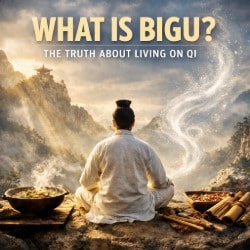
Taoist practitioner meditating in the mountains, illustrating the concept of Bigu and the idea of “living on Qi

Introduction

If you’ve come across the term Bigu, you may have heard some striking claims.

That ancient Taoists stopped eating and lived on breath alone.
That Bigu is a secret fasting method tied to Qi Gong.
Or that it’s a dangerous practice best left buried in history.

None of those explanations quite land.

Bigu (辟谷) is a real historical practice—but one that has been repeatedly misunderstood when removed from its original context. It was never a universal fast, never a promise of supernatural nourishment, and never meant to be practiced recklessly.

This article explains Bigu plainly:

  • what the term actually means

  • how it was historically practiced

  • why it’s often misunderstood today

  • and how modern readers should interpret it safely

No prior knowledge of Taoism or Qi Gong is required.

What Does “Bigu” Actually Mean?

The term Bigu literally translates as “avoiding grains.”

That detail matters.

In classical Chinese usage, gu (谷) referred specifically to staple grains such as rice, millet, wheat, and barley. These foods were the foundation of daily life, physical labor, and agricultural society. Avoiding them carried symbolic, medical, and practical meaning.

Bigu did not mean “stop eating entirely.”
It meant temporarily abstaining from grain-based staples, often while still consuming vegetables, herbs, broths, or medicinal preparations.

In Taoist contexts, Bigu was never a standalone diet. It was part of a larger cultivation framework that could include:

  • breathing practices

  • Dao Yin or Qi Gong–like movement

  • herbal medicine

  • ritual timing

  • and physician or teacher oversight

Understanding Bigu requires seeing it as situational, not absolute.

Bigu Was Not One Single Practice

One of the most common modern errors is treating Bigu as a single, standardized technique. Historically, it was not.

Different Taoist texts and lineages used the term Bigu to describe different levels of grain avoidance, including:

  • short-term abstention during purification or retreat

  • medically guided reduction during illness or digestive overload

  • preparatory phases before intensive meditation

  • symbolic discipline during ritual observances

Some forms lasted days.
Some lasted weeks.
A small number of historical figures practiced more extreme versions—but these were exceptions, not the norm.

As Livia Kohn and other Daoist scholars note, Bigu was always embedded in a system of regulation, not practiced in isolation.

Why Grains Were Targeted Historically

To modern readers, targeting grains can sound ideological or arbitrary. Historically, it was neither.

In classical Chinese medical theory, grains were considered:

  • dense

  • warming

  • and metabolically demanding

For agricultural laborers, that was essential.
For practitioners focused on internal regulation and subtle awareness, heavy grain consumption was sometimes viewed as overstimulating digestion and dampening sensitivity.

This was not a moral judgment. Grains were not considered “bad.” They were simply not always appropriate during certain phases of training or healing.

Texts such as the Baopuzi discuss grain avoidance not as deprivation, but as temporary reduction of digestive load in service of a specific goal.

The Myth of “Living on Qi”

Perhaps the most persistent misconception around Bigu is the idea that Taoist practitioners sought to survive without food entirely, living on breath, Qi, or ambient energy.

This idea largely comes from:

  • metaphorical language taken literally

  • later hagiographies (stories) rather than early medical texts

  • and modern spiritual marketing

Classical Taoist writings do describe reducing reliance on “coarse nourishment,” but they also emphasize:

  • gradual transition

  • supplementation

  • and supervision

When historical figures were described as “living lightly” or “feeding on Qi,” this often referred to:

  • reduced appetite

  • improved metabolic efficiency

  • or symbolic attainment

Taken metaphorically, the language makes sense. Taken literally, it becomes dangerous—and historically inaccurate.

How Bigu Is Commonly Misused Today

In modern wellness culture, Bigu is sometimes reframed as:

  • extreme fasting

  • spiritualized calorie restriction

  • or proof of discipline through deprivation

This is where Bigu becomes risky.

Stripped of its historical structure, Bigu can be misapplied in ways that ignore:

  • individual health conditions

  • nutritional needs

  • and modern medical understanding

From a contemporary health perspective, unsupervised prolonged fasting carries real risks, including electrolyte imbalance, muscle loss, hormonal disruption, and nervous system stress—especially for active individuals.

Historical Taoists were aware of risk. That’s why Bigu was regulated, contextual, and rarely permanent.

How Modern Readers Should Understand Bigu Safely

For modern readers—especially those interested in Qi Gong or wellness—Bigu is best approached as a concept, not a prescription.

Its value today lies in what it points toward:

  • mindful eating

  • temporary dietary simplification

  • reduced metabolic overload

  • and awareness of how diet affects internal state

Safe modern interpretations often involve:

  • reducing highly refined carbohydrates

  • simplifying meals during low-intensity periods

  • aligning diet with recovery rather than performance

  • avoiding extremes altogether

In this way, Bigu becomes informational, not literal.

Bigu and Qi Gong: The Missing Context

Historically, Bigu was almost always paired with movement and breath practices.

Qi Gong–like exercises helped:

  • maintain circulation

  • regulate the nervous system

  • prevent stagnation during dietary restraint

Without those supports, grain avoidance was considered incomplete—and potentially harmful.

This pairing matters for modern readers. Diet alone was never the point.

Final Perspective

Bigu is not a shortcut.
It is not a test of spiritual toughness.
And it is not a recommendation for prolonged food avoidance.

It is a historical practice, developed within a system that treated food, movement, breath, and rest as inseparable.

Approached with curiosity, Bigu offers insight into how earlier practitioners understood digestion and restraint. Approached literally or competitively, it loses both its meaning and its safety.

As with much of Taoist practice, Bigu’s value lies not in imitation—but in interpretation.

Sources & Further Reading

The interpretations in this article draw from a combination of classical Taoist texts, modern scholarship, and contemporary medical perspectives.

Classical & Scholarly Sources

  • Kohn, Livia. Daoism and Chinese Culture

  • Kohn, Livia. Early Chinese Mysticism

  • Campany, Robert Ford. To Live as Long as Heaven and Earth

  • Ge Hong (葛洪). Baopuzi (抱朴子), translated excerpts

  • Schipper, Kristofer. The Taoist Body

Practice & Medical Context

  • Despeux, Catherine. “Gymnastics: The Ancient Tradition of Dao Yin”

  • Longo, Valter, MD, PhD. The Longevity Diet

  • Harvard Health Publishing – Intermittent Fasting & Metabolic Stress

  • National Institutes of Health (NIH) – Fasting and metabolic health research

Reader Safety Note

This article is educational and historical in nature. It does not recommend fasting or dietary restriction without appropriate medical guidance. Individuals with metabolic, endocrine, cardiovascular, or eating-related conditions should consult qualified healthcare professionals before making dietary changes.

Carry your practice beyond the mat.

The Refined Qi Gong Collection blends stillness and style — inspired by the same principles you train with.

Explore the Collection →

Frequently Asked Questions About Bigu

What is Bigu in Taoism?

Bigu is a historical Taoist practice whose name literally means “avoiding grains.” Rather than complete fasting, it usually involved temporarily abstaining from staple grains such as rice or wheat while still consuming other foods, herbs, or broths. Bigu was practiced as part of a broader system that included movement, breathing practices, and medical oversight.

Does Bigu mean not eating at all?

No. Bigu did not mean total food abstinence. Most historical references describe regulated grain avoidance, not starvation. The idea that Taoist practitioners stopped eating entirely comes from later interpretations and metaphorical language taken too literally.

What does “living on Qi” actually mean?

“Living on Qi” is largely symbolic language. In classical Taoist texts, it often referred to reduced dependence on heavy foods, improved efficiency of digestion, or spiritual attainment—not literal survival without food. Interpreting this phrase literally can be misleading and unsafe.

Is Bigu the same as fasting?

Not exactly. While Bigu shares surface similarities with fasting, it was more specific and contextual. It focused on avoiding grains rather than eliminating all food and was typically practiced for limited periods alongside movement and breathing practices.

Is Bigu safe to practice today?

Bigu is best understood as a historical concept rather than a modern health prescription. Unsupervised grain avoidance or fasting can pose health risks, especially for people with medical conditions or high activity levels. Any dietary changes should be approached cautiously and, when appropriate, with medical guidance.

How should modern Qi Gong practitioners understand Bigu?

For modern practitioners, Bigu offers insight into how earlier Taoists thought about digestion, energy use, and restraint. Its relevance today lies in mindful eating and balance—not extreme dietary restriction or deprivation.

Leave a Reply