Taoist Winter Warming Bowl Recipe for Qi Gong Practice
A warming, kidney-supportive recipe to boost your Qi Gong training in late fall and early winter.
Flagstaff, AZ USA
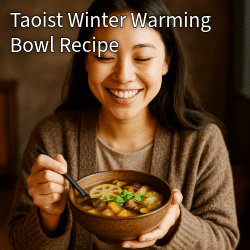
Late fall and early winter are the deepest yin seasons of the year. The daylight fades, the temperature drops, and your body begins leaning on its internal reserves far more than it did in summer or even early autumn. For anyone practicing Qi Gong—especially for healing, circulation, or stress reduction—this seasonal shift is more than atmospheric. It’s biological.
This is where the Taoist seasonal diet comes in. And despite what popular culture suggests, it is not a vegetarian diet. Far from it. In winter, Taoist kitchens traditionally bring in small, intentional amounts of warming meats like chicken, duck, or fish to support the kidneys, build core energy, and protect the joints.
Today’s recipe is built with that spirit in mind. Simple, warming, deeply nourishing, and aligned with what the body—and your Qi Gong practice—needs most during the cold months.
Let’s start with the seasonal context before we hit the stove.
In Taoist internal arts, winter belongs to the Water Element and the Kidney system, which includes:
Core energy reserves (jing)
Lower back stability
Tendon and joint nourishment
Warmth and circulation
Stress regulation
Emotional steadiness
These are also the functions that most influence how your Qi Gong feels.
In late fall and winter, practitioners often notice:
More stiffness in the joints
Slower warm-ups
Faster fatigue
Increased stress sensitivity
A need for deeper, slower movements
Warm, mineral-rich, easily digested foods help stabilize these seasonal effects. That’s why the Taoist winter diet emphasizes soft textures, slow-cooked ingredients, warming spices, and moderate protein.
This is not about restriction.
It’s about functional nourishment to support your practice.
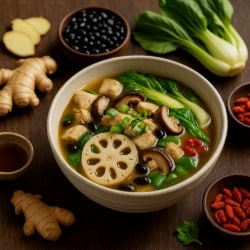
A late-fall & early-winter recipe aligned with Taoist dietary principles and supportive of Qi Gong training.
Broth base
4 cups vegetable or light chicken broth
4–5 slices fresh ginger
1 clove garlic, gently crushed
1 tbsp rice wine or mirin
1 tsp light soy sauce or coconut aminos
Optional: small piece of kombu (for minerals)
Vegetables & Protein
1 cup sliced lotus root
1 cup napa cabbage or bok choy
½ cup sliced shiitake mushrooms
½–1 cup small diced chicken thigh or soft tofu
½ cup cooked black beans or adzuki beans
Seasoning & Finish
1 tsp toasted sesame oil
1–2 green onions
Optional: white pepper
Optional: a few goji berries
Warm the broth
Combine broth, ginger, garlic, rice wine, and soy sauce. Heat gently until steaming. Avoid boiling to keep the flavor soft and the energetics gentle.
Add lotus root and mushrooms
Simmer 8–10 minutes until lotus root begins to soften.
Add greens and protein
Add chicken or tofu and bok choy/napa cabbage. Simmer another 5–7 minutes, keeping the heat low and steady.
Add beans and finish
Stir in black beans or adzuki beans. Add sesame oil and goji berries. Let rest off heat for 2 minutes.
Serve warm
Top with green onion and a pinch of white pepper if desired.
Moistens dryness while grounding the lower body—ideal for cold, dry months.
Supports Spleen Qi and keeps the “inner stove” lit.
Source: Integrative Medicine Research, 2020.
Beta-glucans and mineral density help counter cold-season stiffness.
Source: Nutrients, 2017.
In Taoist cooking, small amounts of ethically raised meat are used to strengthen the body for winter training—not to overburden digestion.
Warm, soft foods reduce digestive strain and improve nutrient absorption, allowing your Qi Gong routines to feel smoother and more powerful.
This Winter Warming Bowl pairs especially well with the routines from:
Both online courses help practitioners stay warm internally, improve circulation, and develop calm energy during the cold months. Eat the bowl 1–2 hours before morning training, or use it as a post-practice evening meal when temperatures drop.
Winter Qi Gong is about depth, not speed.
This bowl helps you get there.
Carry your practice beyond the mat.
The Refined Qi Gong Collection blends stillness and style — inspired by the same principles you train with.
No. Traditional Taoist winter cooking includes small, intentional amounts of meat such as chicken, duck, or fish. These foods help warm the kidneys and support energy during cold seasons. Tofu works as a substitute, but the classical recipe is not vegetarian by default.
Most practitioners eat it 1–2 hours before morning practice or as a grounding evening meal after training. Its warm, soft, and nourishing qualities support circulation and lower-body strength.
Yes. If lotus root isn’t available, daikon radish, burdock root, or sweet potato can be used. These still align with the Taoist winter dietary principle of nourishing the kidneys and strengthening the lower body.
Many of the ingredients—such as ginger, shiitake mushrooms, and mineral-rich kombu—support winter joint comfort and circulation. These effects pair well with Qi Gong for reducing seasonal stiffness.
This dish is ideal for practitioners following Awaken and Enliven or 6 Easy Steps to a Life With Qi, as both courses emphasize circulation, grounding, and seasonal internal balance.
Qi Gong and Nutrition: How Food Fuels Energy, Balance, and Longevity
Geography and Qi Gong Diets: How Climate and Location Shape Energetic Nutrition
Buddhism, Vegetarianism, and Qi Gong: How Buddhist Diets Shaped East Asian Qi Gong Traditions
Qi Gong and Confucian Moderation: The Art of Balance in Practice and Life
Qi Gong and Autumn Eating: Roots, Grains, and Seasonal Transition