Qi Gong and Digestive Health: Strengthening the Middle Burner
Digestive health is the foundation of energy, recovery, and aging resilience. Learn how qi gong strengthens the Middle Burner, supports gut function, and reduces inflammation.
Flagstaff, AZ USA
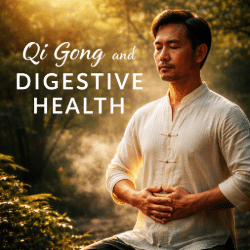
If you’ve trained long enough — martial arts, strength work, or even seated meditation — you eventually notice something simple:
When digestion falters, everything else follows.
Energy drops.
Recovery slows.
Inflammation creeps in.
Joints stiffen.
Mood shifts.
Modern physiology now confirms what traditional Chinese medicine described centuries ago: digestive health is not a side system. It is foundational.
In classical terminology, this foundation is called the Middle Burner — the functional system responsible for transforming food into usable energy.
In modern language, we might call it metabolic efficiency.
Let’s examine what that actually means.
In traditional Chinese medicine (TCM), the body is described through three functional divisions:
Upper Burner – respiration and circulation
Middle Burner – digestion and transformation
Lower Burner – elimination and reproductive function
The Middle Burner is primarily associated with the Spleen and Stomach systems — not as anatomical organs alone, but as functional processes responsible for:
Breaking down food
Extracting nutrients
Distributing energy
Managing fluid balance
In biomedical terms, this includes:
Gastric acid production
Pancreatic enzyme secretion
Small intestine absorption
Blood glucose regulation
Gut-immune signaling
While the terminology differs, the underlying principle is shared: digestion determines systemic vitality.
And that’s where qi gong and digestive health intersect.
Approximately 70% of immune tissue resides in the gut-associated lymphoid tissue (GALT) (Mayer, 2011). The gastrointestinal tract is not just a digestive tube — it is an immune organ, an endocrine regulator, and a neurological interface.
Research on the gut-brain axis demonstrates:
Stress alters gut permeability
Cortisol disrupts microbiome balance
Chronic sympathetic activation impairs motility
(Cryan & Dinan, 2012; Konturek et al., 2011)
This matters because systemic inflammation often begins with digestive dysregulation.
When gut barrier integrity weakens, inflammatory signaling increases. Elevated inflammatory cytokines such as IL-6 and TNF-α are associated with:
Joint pain
Slower tissue repair
Fatigue
Accelerated aging
Digestive health is not isolated. It is upstream.
Now we get specific.
Qi gong for digestion works primarily through nervous system regulation.
Digestion requires parasympathetic dominance — the “rest and digest” state.
Slow diaphragmatic breathing has been shown to:
Increase vagal tone
Reduce sympathetic overdrive
Improve gastrointestinal motility
(Streeter et al., 2012)
Many forms of qi gong emphasize slow nasal breathing with abdominal expansion. This mechanical and neurological stimulation enhances vagus nerve activity, which directly regulates digestive function.
In plain terms: if your nervous system is stuck in fight-or-flight, your stomach and intestines slow down.
Qi gong restores the proper sequence.
Gentle rotational movements and standing postures improve abdominal blood flow and lymphatic return.
Exercise-based studies demonstrate that moderate, rhythmic movement enhances:
Mesenteric circulation
Glucose metabolism
Insulin sensitivity
Regular practice of qi gong for digestive health may therefore improve nutrient absorption and metabolic stability — especially in aging populations.
Meta-analyses examining qi gong and tai chi show reductions in inflammatory biomarkers including CRP and IL-6 (Bower et al., 2014).
Lower systemic inflammation:
Reduces joint pain
Improves recovery
Supports healthy aging
Which is precisely why this topic anchors your stress, inflammation, joint pain, and aging clusters.
This is where many people miss the connection.
Poor digestion → poor nutrient extraction.
Poor nutrient extraction → impaired collagen synthesis.
Impaired collagen synthesis → joint degeneration.
Protein digestion efficiency declines with age. Gastric acid production may decrease. Pancreatic enzyme output shifts. Microbiome diversity changes (O’Toole & Jeffery, 2015).
If digestion weakens, musculoskeletal resilience follows.
Strengthening the Middle Burner is metabolic maintenance.
Slow nasal inhale.
Lower abdomen expands.
Long relaxed exhale.
This mechanically massages digestive organs and stimulates vagal tone.
Slow rotational movement mobilizes the fascia surrounding abdominal organs and improves circulation.
Twenty to forty relaxed repetitions is sufficient.
Even five to ten minutes of relaxed walking after meals improves glucose control and digestion.
This is one of the most overlooked interventions in modern health.
Traditional systems emphasize warm, cooked foods when digestion is weak. Interestingly, modern research supports the idea that cooking increases bioavailability of certain nutrients and reduces digestive workload.
To support digestive health:
Prioritize whole foods
Ensure adequate protein intake
Include fermented foods for microbiome diversity
Limit ultra-processed foods associated with inflammation
Protein intake in aging adults is especially critical for preserving lean mass and joint integrity (Phillips et al., 2016).
Qi gong supports regulation. Nutrition supplies material.
Both are required.
Persistent abdominal pain, gastrointestinal bleeding, unexplained weight loss, or dramatic bowel changes require evaluation by a licensed medical professional.
Qi gong is supportive. It is not a replacement for medical diagnosis or treatment.
Strengthening the Middle Burner means:
Stabilizing blood sugar
Reducing inflammatory load
Improving nutrient absorption
Enhancing recovery
Preserving vitality with age
Qi gong and digestive health are not abstract concepts. They are a practical nervous-system intervention that improves one of the body’s most central regulatory hubs.
If you want better joints, clearer thinking, and stronger aging, start at the center.
Strengthen digestion.
Everything else builds from there.

Designed for practitioners — wearables, journals, and keepsakes shaped by stillness.
Explore the Refined Qi Gong Collection →The following peer-reviewed studies and reviews support the physiological mechanisms discussed in this article, including the gut–brain axis, inflammatory signaling, parasympathetic regulation, and digestive changes associated with aging.
Mayer, E. A. (2011). Gut feelings: The emerging biology of gut–brain communication. Nature Reviews Neuroscience, 12(8), 453–466.
https://doi.org/10.1038/nrn3071
Cryan, J. F., & Dinan, T. G. (2012). Mind-altering microorganisms: The impact of the gut microbiota on brain and behaviour. Nature Reviews Neuroscience, 13(10), 701–712.
https://doi.org/10.1038/nrn3346
Konturek, P. C., Brzozowski, T., & Konturek, S. J. (2011). Stress and the gut: Pathophysiology, clinical consequences, and diagnostic approach. Journal of Physiology and Pharmacology, 62(6), 591–599.
Streeter, C. C., et al. (2012). Effects of yoga on the autonomic nervous system, gamma-aminobutyric acid, and allostasis in epilepsy, depression, and PTSD. Medical Hypotheses, 78(5), 571–579.
(Supports slow breathing and vagal activation mechanisms.)
Bower, J. E., et al. (2014). Tai Chi Chih reduces inflammatory markers in breast cancer survivors. Psychoneuroendocrinology, 43, 1–9.
(Demonstrates meditative movement reducing inflammatory cytokines.)
O’Toole, P. W., & Jeffery, I. B. (2015). Gut microbiota and aging. Science, 350(6265), 1214–1215.
https://doi.org/10.1126/science.aac8469
Phillips, S. M., et al. (2016). Protein requirements and aging: Effects on muscle and functional performance. The American Journal of Clinical Nutrition, 103(2), 738S–745S.
Derrien, M., et al. (2019). The gut microbiota in metabolic health and disease. Nature Reviews Endocrinology, 15(6), 321–336.
Qi gong may support digestion by activating the parasympathetic nervous system, which regulates stomach acid production, enzyme secretion, and intestinal motility. Slow breathing and gentle movement improve vagal tone, which directly influences gut function and digestive efficiency.
In traditional Chinese medicine, the Middle Burner refers to the functional system responsible for transforming food into energy. Qi gong strengthens the Middle Burner by improving circulation to abdominal organs, reducing stress hormones, and supporting metabolic regulation.
Gentle abdominal breathing and waist rotations may help reduce bloating by improving gastrointestinal motility and decreasing stress-related digestive slowing. Many practitioners report improved comfort when practicing qi gong regularly, especially after meals.
Research on meditative movement practices such as qi gong and tai chi shows reductions in inflammatory markers like C-reactive protein (CRP) and IL-6. Lower systemic inflammation may support overall gut health and immune balance.
Qi gong supports the gut-brain axis by reducing sympathetic dominance and enhancing vagus nerve activity. Since the vagus nerve directly connects the brain and digestive tract, improved regulation may support both digestive health and stress resilience.
Some people notice improvements in relaxation and abdominal comfort within a few sessions. However, meaningful improvements in digestive regulation typically require consistent practice over several weeks.
No. Qi gong is a supportive wellness practice and should not replace medical evaluation or treatment. Persistent abdominal pain, bleeding, unexplained weight loss, or significant digestive changes require professional medical assessment.
Qi Gong and Nutrition: How Food Fuels Energy, Balance, and Longevity
Geography and Qi Gong Diets: How Climate and Location Shape Energetic Nutrition
Qi Gong Diets for Arid and High-Desert Regions
What Is Qi Gong? A Beginner’s Guide to Energy Healing
Buddhism, Vegetarianism, and Qi Gong: How Buddhist Diets Shaped East Asian Qi Gong Traditions
Qi Gong and Confucian Moderation: The Art of Balance in Practice and Life
Qi Gong and Autumn Eating: Roots, Grains, and Seasonal Transition
Taoist Winter Warming Bowl Recipe for Qi Gong Practice
Break the Stress Anxiety Cycle With Qi Gong and Nutrition
Qi Gong and Digestive Health: Strengthening the Middle Burner