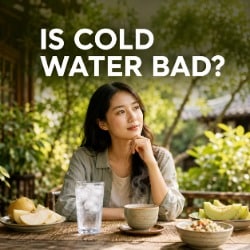
So, Is Cold Water Bad for You?
For most healthy adults, current evidence does not show that drinking cold water damages normal digestion.
That is the modern side of the answer.
The traditional Chinese side is more conditional than it is often made to sound. Chinese medicine treats Cold as one influence among many and pays considerable attention to constitution, illness, season, environment, and the larger pattern of symptoms. Its classical literature does not provide a simple universal command that everyone must avoid cold water.
Modern physiology, meanwhile, confirms something smaller but still interesting: the digestive tract responds to temperature. Cold and hot liquids can temporarily affect stomach temperature, gastric emptying, and esophageal movement. The research demonstrating these effects is often based on small studies, and physiological change should not be confused with evidence of harm.
So the disagreement between Chinese medicine and modern nutrition is not quite the contest it first appears to be.
They are often asking different questions.
Modern health research asks whether cold water produces measurable benefits or harms in human populations.
Chinese medicine asks whether Cold is appropriate for this particular person, displaying this particular pattern, under these particular conditions.
Those questions arise from very different medical traditions.
Occasionally, however, they lead to compatible practical advice.
If you like cold water and tolerate it well, there is little evidence-based reason to fear it.
If very cold drinks reliably make you uncomfortable, nothing nutritionally important is lost by trying them warmer.
When you are exercising or spending time in significant heat, drinking enough fluid matters more than obeying a blanket rule about beverage temperature.
And if you have persistent pain, repeated digestive problems, difficulty swallowing, unexplained weight loss, vomiting, blood in the stool, or other significant symptoms, the answer is not to keep experimenting with the temperature of your tea. Seek appropriate medical care.
The more interesting late-summer lesson is not whether the ice cube is innocent or guilty.
It is that food and drink never exist entirely apart from the person consuming them.
Season matters. Environment matters. Quantity matters. Habit matters. The individual matters.
Chinese medicine and modern nutritional science arrive at that observation by very different roads.
Occasionally, they still find themselves standing in roughly the same place.
So if your stomach has been telling you for ten years that it prefers the tea warm, you are not required to conduct a philosophical argument with it.
Sometimes the Taoist answer really is that simple.