High-Desert Congee for Qi Gong Practice
A simple congee recipe adapted for arid and high-desert climates, supporting hydration, digestion, and recovery for qi gong practice in low humidity.
Flagstaff, AZ USA
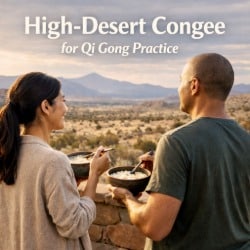
In arid and high-desert environments, hydration is not just about how much water is consumed—it is about how well the body holds moisture. Dry air accelerates fluid loss through breath and skin, placing quiet stress on joints, connective tissue, and recovery. For qi gong practitioners, this makes food choice a functional part of practice.
Congee, a slow-cooked rice porridge, has been used for centuries as a foundational food in dry, demanding conditions. Properly prepared, it hydrates gently, supports digestion, and preserves yin without burdening the system.
Classical dietary texts consistently recommend soft, moist, and warm foods when dryness is present. The Huangdi Neijing emphasizes that dryness depletes fluids first and weakens the body’s ability to anchor activity and rest.
Congee addresses this directly by:
Delivering water in a digestible form
Supporting fluid absorption rather than rapid elimination
Reducing digestive strain during environmental stress
Providing a neutral base that adapts to individual needs
Modern nutrition research supports this approach. Hydration is more effective when fluids are paired with carbohydrates, minerals, and gentle warmth—exactly what congee provides.
Congee is often confused with rice pudding, especially in Western kitchens. While both are rice-based and slow-cooked, their functions are very different.
Rice as a base grain
High liquid-to-grain ratio
Soft, easily digested texture
| Aspect | Congee | Rice Pudding |
|---|---|---|
| Primary role | Therapeutic staple and daily-use comfort food. | Dessert or occasional treat. |
| Flavor profile | Neutral to savory (easy to customize). | Sweet-forward, often spiced and rich. |
| Typical cooking liquid | Water or broth. | Milk, cream, or sweetened alternatives. |
| Sugar content | Minimal to none by default. | Moderate to high in common recipes. |
| Digestive impact | Gentle and supportive, especially in dry climates. | Can feel heavy if used frequently or made very rich. |
| Climate suitability (high desert) | Excellent: supports hydration through food. | Situational: better as an occasional, seasonal option. |
| Practice alignment | Pairs well before/after qi gong practice. | More of a comfort dessert than a practice staple. |
Rice pudding may be appropriate as a seasonal treat, particularly in cold weather, but it does not serve the same hydrating or stabilizing role as congee—especially in low-humidity environments.
This recipe is intentionally simple. Complexity can be added later through toppings or variations, but the base should remain neutral and reliable.
½ cup white rice (short or medium grain)
6–7 cups water
1 tablespoon black sesame seeds (lightly ground)
1 teaspoon chia seeds
1–2 goji berries (optional)
Small pinch of sea salt
Rinse the rice until the water runs mostly clear.
Combine rice and water in a pot and bring to a gentle boil.
Reduce heat and simmer uncovered for 60–90 minutes, stirring occasionally.
Add sesame seeds, chia seeds, and goji berries during the final 10 minutes.
Season lightly with sea salt and allow to rest for several minutes before serving.
Best consumed warm
Suitable before or after qi gong practice
Can be eaten daily in arid or high-desert climates
Seeds are small, but their nutritional role is significant in dry climates. Black sesame and chia seeds provide fats and soluble fiber that help the body retain moisture and protect connective tissue.
From a classical perspective, seeds nourish yin and essence. From a modern standpoint, they support joint lubrication, digestive regularity, and hydration efficiency—key concerns in low humidity.
Timing matters as much as ingredients.
Morning: supports hydration after overnight fluid loss
Post-practice: aids recovery without digestive strain
Seasonal transitions: stabilizes digestion during weather shifts
Late-night consumption should be lighter, especially for those with sensitive digestion.
Congee’s strength is adaptability. In arid regions, small adjustments improve alignment:
Use slightly more water than usual
Favor warming preparation over cold toppings
Avoid excessive sugar or dairy additions
Emphasize mineral-rich add-ins during heavy practice periods
These changes help maintain internal balance even as external conditions fluctuate.
Congee is not a trend food. It is a functional staple that has endured because it works—across cultures, climates, and centuries.
For qi gong practitioners in dry or high-desert environments, it provides:
Reliable hydration support
Digestive stability
Joint and connective tissue protection
A calm nutritional base that complements practice
This makes congee an ideal anchor recipe within a broader qi gong nutrition strategy.
Huangdi Neijing (Yellow Emperor’s Classic of Internal Medicine)
Pitchford, P. Healing with Whole Foods
Popkin, B. et al. “Water, Hydration, and Health.” Nutrition Reviews
Sawka, M. et al. “Exercise and Fluid Replacement.” American College of Sports Medicine
Carry your practice beyond the mat.
The Refined Qi Gong Collection blends stillness and style — inspired by the same principles you train with.
In arid and high-desert regions, congee can be eaten regularly, including daily if digestion is comfortable. Its soft texture and high moisture content make it well suited for dry climates where fluid loss is ongoing.
Congee works well either before or after practice. A small bowl beforehand can support hydration and steady energy, while a post-practice serving aids recovery without placing strain on digestion.
Yes. Congee stores well when refrigerated and can be reheated gently with additional water as needed. This makes it practical for batch cooking and consistent use during busy or physically demanding periods.
Congee is highly adaptable. Seeds, grains, or light flavor additions can be adjusted based on preference, as long as the base remains simple and not overly sweet or heavy.
Yes. In warmer months, congee can be prepared lighter and thinner. In cooler seasons, it can be cooked longer or paired with warming additions to better support digestion and comfort.
Qi Gong and Nutrition: How Food Fuels Energy, Balance, and Longevity
Geography and Qi Gong Diets: How Climate and Location Shape Energetic Nutrition
Qi Gong Diets for Arid and High-Desert Regions
What Is Qi Gong? A Beginner’s Guide to Energy Healing
Buddhism, Vegetarianism, and Qi Gong: How Buddhist Diets Shaped East Asian Qi Gong Traditions
Qi Gong and Confucian Moderation: The Art of Balance in Practice and Life
Qi Gong and Autumn Eating: Roots, Grains, and Seasonal Transition