Flagstaff, AZ USA

Luzon’s Legacy: The Martial Arts Traditions of Northern Philippines

From pre-colonial warrior tribes to Modern Arnis and Kombatan, discover how the northern Philippines shaped the evolution of Filipino Martial Arts and preserved a living heritage of rhythm, resilience, and skill.
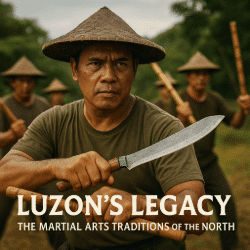
Filipino martial artist in Luzon wearing a traditional salakot, holding a bolo and rattan stick in authentic arnis stance, surrounded by fellow practitioners training outdoors under cloudy skies.

The Northern Pulse of Filipino Martial Arts

When most people talk about Filipino Martial Arts (FMA), their minds jump to the stick-fighting masters of Cebu or the blade-wielding warriors of Mindanao. Yet the story of FMA isn’t complete without Luzon — the largest and most diverse island in the Philippines.

Luzon has always been the nation’s cultural and political heart, a crossroads where tribal heritage, Spanish colonization, and modern innovation collided. From the mountain tribes of the north to the urban sprawl of Manila, its martial traditions evolved as acts of defense, rebellion, and cultural survival.

In Luzon, arnis, eskrima, and kali aren’t just arts — they’re living records of the Filipino instinct to adapt and endure.

Roots of Resistance: Pre-Colonial and Tribal Combat Traditions

Before Spain arrived in the 16th century, the people of Luzon already had sophisticated combat systems. Among Tagalog, Ilocano, and Pampangan communities, martial skill wasn’t a hobby — it was a necessity.

Warfare between barangays (villages) was frequent, often over trade routes or honor. Warriors carried rattan shields, short spears, bolos, and kampilan-like swords. Wooden training versions of these weapons gave rise to the stick-based drills that would later define Arnis.

Tribal warfare demanded quick reflexes and improvisation — traits still visible in the flowing, reactive nature of FMA. To the pre-colonial fighter, combat was less about sport and more about reading the rhythm of danger. In that rhythm lies the origin of the Filipino “flow.”

The Spanish Encounter and the Birth of Arnis

When Spanish conquistadors arrived, they met not a passive people but a warrior culture. Over the centuries of colonization, native fighters absorbed what they saw — the stance, timing, and linear thrusts of Spanish fencing — and blended them with their indigenous arts.

The result became known as arnis de mano (“harness of the hand”), a phrase drawn from the decorative arnés or armor used in Spanish duels. Early masters began to codify their movements into anyo (forms) and abaniko (fan) strikes, preserving combat knowledge under the guise of dance.

Arnis wasn’t just resistance — it was cultural camouflage. While colonial authorities tried to suppress native weapon training, Filipino practitioners hid their techniques in performances, festivals, and even folk plays.

The Luzon Schools: Modern Arnis, Kombatan, and Urban Lineages

By the mid-20th century, Luzon had become the epicenter of organized FMA. The war years had proven the effectiveness of traditional weapon skills, and the post-war era demanded structure, ranking, and teaching systems.

Modern Arnis, founded by Remy Presas in Manila, sought to unify FMA under a national banner. Presas emphasized flow, practicality, and the use of sticks as extensions of the body. His curriculum introduced sparring gear, structured drills, and sport competition — innovations that brought Arnis into schools and universities.

His brother, Ernesto Presas, took a different path, developing Kombatan, a system with a harder, more militarized edge. It preserved the blade-based tactics and incorporated empty-hand applications like locks, throws, and takedowns.

Meanwhile, Pekiti-Tirsia Kali, originally from the Visayas, spread widely in Luzon through military and police training. Systems such as Balintawak, Doce Pares, and Manila’s Yambao-Villabrille lineage thrived in urban dojos and public parks, blending modern instruction with traditional baston drills.

Each system reflected the Luzon ethos: a blend of discipline, adaptability, and practical survival.

Weapons and Principles of the North

In Luzon, weapon selection mirrors the landscape — practical, versatile, and unpretentious.

The rattan stick remains the training core, light enough for speed but strong enough for control. The bolo, a working blade for field and kitchen alike, became both weapon and symbol of resistance. Larger swords like the kampilan appeared in ceremonial forms, while shorter daggers, or daga, carried the lessons of close-quarters combat.

Unlike some southern systems, Luzon styles often emphasize range transition — the ability to shift smoothly from long weapon to close grip, and finally to empty-hand. The same rhythm governs everything: distance, timing, and awareness.

When seen this way, Luzon’s martial philosophy isn’t about domination — it’s about balance. Every strike, block, or disarm is an act of equilibrium.

From Resistance to Representation: FMA in the Modern Era

The 20th century brought Luzon’s martial arts into public consciousness. Filipino veterans returning from World War II demonstrated FMA to American soldiers. The arts began to appear in self-defense manuals, and by the 1970s, Filipino masters were teaching internationally.

The Arnis Act of 2009 finally declared Arnis the national martial art and sport of the Philippines, a move that recognized both its practical and cultural value. In many schools, FMA classes now sit alongside basketball and dance, a symbolic merging of history and identity.

Outside the Philippines, Luzon-based systems like Modern Arnis and Kombatan became ambassadors of Filipino culture, shaping how the world perceives the nation’s fighting spirit.

Living Tradition: Why Luzon Matters Today

When you train in a Luzon-style FMA system, you’re practicing more than strikes and blocks — you’re stepping into a living current of Filipino resilience.

Every parry and counter speaks of ancestors who refused to be erased. Every drill echoes a story of adaptation, from bamboo fields to city alleys. The discipline of FMA doesn’t just strengthen the body; it revives the cultural pulse of a people who survived conquest through creativity.

As Master Remy Presas once said, “Arnis is our heritage. To lose it is to lose a part of ourselves.”

For the modern martial artist, Luzon’s legacy offers a reminder that mastery isn’t just about skill — it’s about remembering where those skills came from, and ensuring they live on.

Arnis practitioner honoring Filipino martial arts heritage

Carry the Lineage Forward

From the villages of Luzon to the rhythm of the modern world, the art of Arnis endures—grace in motion, history in every strike. The Water Mountain Arnis Collection honors that lineage with apparel inspired by the forms, spirit, and brotherhood of Filipino martial arts. Wear what you train. Remember where it began.

Explore the Arnis Collection

Key Figures of the Luzon FMA Tradition

Remy Presas Modern Arnis
Modernizer • Educator • Global ambassador

Unified drills, protective gear, and sport structure brought Arnis into schools and made it accessible worldwide without losing its core flow.

Ernesto Presas Kombatan
Combative emphasis • Blade continuity

Preserved a harder tactical character—locks, throws, and blade-based integrations aimed at practical self-defense and military-minded training.

Leo Gaje Pekiti-Tirsia Kali
Tactical curriculum • Law enforcement adoption

Expanded PTK through Luzon’s military and police circles, focusing on timing, counter-offense, and close-quarters blade methodology.

Antonio “Tatang” Ilustrisimo Kalis Ilustrisimo
Blademaster • Direct, economical motion

Renowned for efficient blade work and real-world timing; his lineage heavily influences modern bladed interpretations across the islands.

Antonio Yambao Historical Chronicler
Manila-based historian • Early Arnis documentation

Helped preserve Manila’s Arnis heritage through writing and instruction, connecting older practices to the urban, post-war generation.

Luzon FMA – Frequently Asked Questions

Q1 What makes Luzon’s Filipino Martial Arts styles unique?
Luzon systems blend indigenous weapon concepts with Spanish fencing timing and footwork. They prize fluid transitions from weapon to empty-hand, guided by distance, timing, and rhythm.
Q2 How does Modern Arnis differ from Kombatan?
Modern Arnis (Remy Presas) emphasizes flow, standardized drills, protective gear, and sport formats. Kombatan (Ernesto Presas) keeps a harder, blade-forward character with locks, throws, and tactical self-defense.
Q3 Did FMA originate in Luzon?
FMA evolved across the archipelago. Luzon’s role was pivotal in organizing, modernizing, and promoting the arts (e.g., Modern Arnis), while earlier influences also came from the Visayas and Mindanao.
Q4 What weapons are common in Luzon practice?
Rattan baston (sticks) for training, the bolo as a working blade, short daga (daggers), and ceremonial use or study of larger swords like the kampilan.
Q5 Is FMA still practiced in Luzon today?
Yes. From Manila gyms to provincial programs, FMA is active and supported by schools and clubs. The Arnis Act of 2009 recognizes Arnis as the national martial art and sport.

Leave a Reply