Flagstaff, AZ USA

The Visayan Crucible: How Cebu and Negros Forged Eskrima’s Fast, Geometric Power

Cebu and Negros shaped the fast, geometric rhythm of Filipino martial arts. In the crowded villages and cane fields of the Visayas, Eskrima evolved into a close-quarter science of timing and efficiency—where every strike, angle, and pivot reflects island life itself.
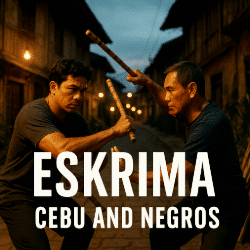
Two Filipino Eskrima practitioners sparring in a narrow Cebu alley at dusk with text overlay “Eskrima Cebu and Negros.”

If Luzon is where Filipino martial arts learned form, the Visayas is where they learned speed.
From the crowded harbors of Cebu to the sugarcane rows of Negros, generations of fighters condensed motion into a geometry of survival. In the tight alleys of island towns, blades met sticks, and sticks met muscle. Eskrima—sometimes spelled escrima or skrimahan—grew here not as ceremony but as compact practicality.

A Geography That Shapes Motion

The Visayas is a broken necklace of islands—Cebu, Negros, Panay, Bohol—each close enough to trade and feud with its neighbor. In these littoral zones, there was no open plain for long-range duels. Combat happened inside barangay compounds, on sugar haciendas hemmed in by rows of cane, or on the decks of trading boats where space was measured in hand-spans.

That geography forced innovation. Instead of the long sweeping strikes favored in the northern systems, Visayan practitioners shortened their arcs and folded footwork into triangles. The result was the signature “close-quarter geometry”—the in-and-out angles, center-line attacks, and tight parries that make Eskrima look almost mathematical.

Spanish Blades and Local Hands

When Spanish sailors and soldiers arrived in the 16th century, they brought espada y daga—the sword-and-dagger method of Iberian fencing. In the Visayas, that art didn’t replace the native blade forms; it fused with them. Cebuano fighters already carried bolo, pinuti, and ginunting. They saw in Spanish fencing a set of usable lines and timing drills, not a foreign creed.

The resulting hybrid became Eskrima (from the Spanish esgrima, “fencing”). But unlike the formal dueling of Europe, Visayan Eskrima stayed tied to field and street. Its weapons were tools first—cane knives, machetes, sticks. Its goal was not elegance but decisiveness. The sugar worker might train with a stick in the evening and use a bolo for harvest at dawn; the motion was the same.

Cebu: The City of Sticks

By the early 1900s, Cebu had become the intellectual center of Eskrima. Dockworkers, policemen, and street toughs sparred behind warehouses or in backrooms lit by kerosene lamps. Informal matches—juego todo, “anything goes”—decided reputation. Out of those contests came lineages still famous today:

  • Doce Pares (Twelve Peers), founded in 1932 by the Cañete and Saavedra families, unified multiple styles under a single banner.

  • Balintawak, born in the 1950s from Teodoro Saavedra’s offshoot, took Eskrima into one-on-one close-range training, emphasizing hand control, limb checking, and economy of motion.

  • Lapunti Arnis de Abanico, created by Filemon Caburnay, retained the abanico (“fan”) strikes of the Visayan tradition but codified them into a symmetrical system of offense and defense.

Cebuano Eskrima became fast—short bursts, whip-like counters, bursts of angular power that left little wasted effort. Observers compared it to jazz: improvisational yet bound by structure.

Negros: The Sugarcane Forge

Across the channel, Negros Occidental refined Eskrima with a different temperament. Sugar wealth created estates where workers, guards, and landowners all practiced the art for different reasons—protection, sport, or prestige. Training happened after long days in the fields, the stalks still whispering in the wind.

Negros systems such as Hinigaran Arnis and Hiraya favored heavier strikes and body evasion. Practitioners learned to slip between the narrow rows of cane—twisting, pivoting, always aware of obstacles. This produced a style both powerful and compressed. Where Cebu emphasized rhythm and hand control, Negros cultivated torque and finishing intent.

Locals said you could tell a man’s island by the way he cut:
Cebu moved like a weaver.
Negros moved like a blacksmith.

Fighting in Tight Quarters

The geometry of confinement became a Visayan hallmark. Whether on a festival stage, in a marketplace, or aboard a ship, fighters trained to operate within arm’s reach. The sinawali double-stick patterns mirrored the interwoven mats used in daily life; triangular footwork echoed the shape of narrow docks. Even the counting patterns—uno dos tres—show Spain’s linguistic residue and the region’s habit of synthesis.

Because combat happened close, timing replaced strength. The art’s philosophy crystallized into the idea that motion should be as short as the distance between heartbeats. In a place where there was never enough room, efficiency became morality.

The Teachers Who Carried the Fire

When World War II reached the islands, many Eskrimadors fought alongside guerrilla units, proving the art’s practicality. After the war, teachers like Venancio “Anciong” Bacon (Balintawak), Ciriaco Cañete (Doce Pares), and Jose Caballero (De Campo Uno-Dos-Tres Orihinal) began formal instruction.

Their methods looked deceptively simple:
a single stick, a small space, a relentless series of counters.
But within that minimalism lay the Visayan essence—clarity under pressure.

Students learned to strike not with anger but geometry; to read the angle, not the face. It was science conducted at wrist length.

Modern Echoes

Today, Visayan Eskrima continues to evolve in dojos and community gyms worldwide. Modern instructors often combine drills from Cebu and Negros, preserving the old while adapting to new contexts—empty-hand defense, police baton, or mixed martial arts.

Yet the soul of the art still hums with island rhythm. Watch a Balintawak demonstration and you’ll see the narrow alleys of Cebu in every pivot. Watch a Negrense stick-fighter and you’ll sense the density of cane fields in each rotation of the hips. Geography still moves through the body.

The Lesson for Practitioners

To study Visayan Eskrima is to study economy itself—not only in motion but in thought. Each strike asks: What is necessary? Each angle answers: Nothing more than this.

That restraint links the art back to its environment, where limitation bred creativity and survival demanded grace. The crowded villages of Cebu and the wind-tossed fields of Negros did not just give birth to a fighting method; they gave birth to a worldview—one where adaptability and awareness outweigh size or aggression.

Closing Reflection

Eskrima’s Visayan roots remind us that martial art is a mirror of circumstance. The art’s fast, geometric rhythm reflects the tempo of island life—pragmatic, unpretentious, and fierce when cornered.

In a world that often rewards spectacle, the Visayan tradition whispers an older truth:
move only as much as needed, and always within the space you have.

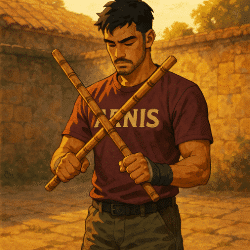
Arnis practitioner honoring Filipino martial arts heritage

Carry the Lineage Forward

From the villages of Luzon to the rhythm of the modern world, the art of Arnis endures—grace in motion, history in every strike. The Water Mountain Arnis Collection honors that lineage with apparel inspired by the forms, spirit, and brotherhood of Filipino martial arts. Wear what you train. Remember where it began.

Explore the Arnis Collection

Frequently Asked Questions

What makes Visayan Eskrima different from other Filipino martial arts?

Visayan Eskrima, particularly from Cebu and Negros, emphasizes compact motion, angular geometry, and fast timing. The art developed in tight spaces—sugarcane fields, village alleys, and ship decks—where efficiency and control mattered more than wide, sweeping strikes.

Why is Cebu considered the center of Eskrima?

Cebu became the intellectual and competitive hub of Eskrima during the 1900s. Styles like Doce Pares, Balintawak, and Lapunti were founded there, shaping modern training through sparring, drills, and structured instruction.

How did Negros influence the development of Eskrima?

Negros practitioners refined Eskrima through the island’s agricultural environment, producing a heavier, torque-based approach. Movements were developed to fit between rows of sugarcane, giving Negros Eskrima its powerful, close-range rhythm.

Is Visayan Eskrima still practiced today?

Yes. Visayan Eskrima is widely practiced in the Philippines and worldwide, often taught under schools like Balintawak, Doce Pares, and Lapunti. Modern instructors preserve traditional drills while adapting them for self-defense, police training, and sports competition.

Leave a Reply