Flagstaff, AZ USA

Arnis as a Lifelong Practice: Health, Stress, and Longevity

Arnis is more than a combat art—it’s a lifelong practice. This article explores how Filipino martial arts support joint health, stress regulation, and cognitive engagement through patterned movement and skill-based training.
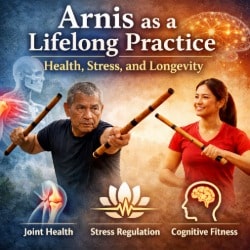
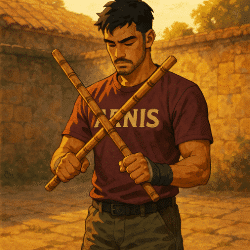
Older and younger practitioners training Arnis with rattan sticks, illustrating Filipino martial arts as a lifelong practice supporting mobility and focus.

Most people first encounter Arnis—also known as Filipino Martial Arts—through images of speed, sticks, and combat drills. It looks sharp. Fast. Intense. And for many, that’s where the story ends.

But if you’ve trained long enough—or watched practitioners age—you begin to notice something else happening beneath the surface.

Arnis isn’t just a fighting art.
It’s a practice—one that quietly trains coordination, stress tolerance, joint health, and cognitive engagement over decades, not years.

That distinction matters.

Because when Arnis is understood only as a combat system, it appeals to a narrow window of life. When it’s understood as a lifelong practice, it becomes something far more rare: a martial discipline that continues to serve the body and mind well into older age.

This article explores that deeper role—grounded not in mysticism or marketing claims, but in how the practice actually works on the human system.

What “Lifelong Practice” Really Means in Martial Arts

In many modern training systems, longevity is accidental. Programs are optimized for performance peaks: strength gains, competitive cycles, short-term results.

Arnis evolved differently.

Historically, it was practiced by people who kept using their bodies—farmers, sailors, laborers, guards—not by specialists who retired at thirty. The art had to remain functional even as speed slowed and strength changed.

A lifelong practice is defined by a few core traits:

  • Scalable intensity – You can train lightly or intensely without changing the art

  • Skill over force – Precision and timing matter more than raw output

  • Variability of movement – Reduces repetitive stress

  • Mental engagement – Keeps the nervous system involved

Arnis checks every one of those boxes.

How Arnis Supports Physical Longevity

1. Joint Health Through Circular, Variable Motion

Unlike many linear striking systems, Arnis relies heavily on circular and diagonal movement patterns.

From the shoulders down through the elbows, wrists, and hands, the joints are constantly moving through changing angles rather than being locked into repetitive paths.

Why this matters:

  • Circular loading distributes stress across connective tissue

  • Grip angles change frequently, reducing overuse

  • Shoulder and elbow joints remain mobile rather than compressed

For aging practitioners—or anyone managing joint stiffness—this variability is protective rather than punishing.

2. Grip Strength Without Grip Damage

Grip strength is one of the strongest predictors of overall functional health as we age. But most grip training is static: heavy lifts, crushing force, repetitive holds.

Arnis trains grip dynamically.

  • Constant micro-adjustments

  • Relaxation and re-engagement

  • Rotation rather than clenching

This develops usable hand strength while preserving finger and wrist health—an underappreciated benefit for longevity.

3. Balance, Footwork, and Fall Prevention

Aging doesn’t usually fail dramatically. It fails quietly—through loss of balance, hesitation, and delayed reaction.

Arnis footwork emphasizes:

  • Weight shifting

  • Directional changes

  • Awareness of spacing

These are the exact skills that reduce fall risk and maintain confidence in daily movement.

Arnis and Stress Regulation: Training the Nervous System

One of the most overlooked aspects of Arnis is how it conditions the nervous system.

Not through relaxation—but through regulated exposure.

Patterned Stress, Not Chaos

Training drills introduce pressure in structured ways:

  • Speed increases gradually

  • Complexity rises without removing control

  • Attention must stay present

This teaches the body how to remain engaged under stress rather than collapsing or panicking.

Over time, practitioners often notice:

  • Faster recovery after stressful events

  • Improved emotional regulation

  • Reduced cognitive rumination

This isn’t accidental. It’s what happens when attention, breath, and movement are trained together.

Breath Happens—Without Making It a “Breath Practice”

In Arnis, breath is rarely taught explicitly. And that’s part of the benefit.

Breathing naturally adapts to rhythm, timing, and exertion. Over time:

  • Exhalation aligns with effort

  • Breath stabilizes under pressure

  • Recovery becomes instinctive

For many practitioners, this carries over into daily stress situations without conscious technique.

Cognitive Longevity: Thinking With the Body

Arnis is often described as “fast,” but speed is a side effect—not the goal.

The real training is cognitive.

Pattern Recognition and Decision-Making

Drills require:

  • Reading intent

  • Choosing responses quickly

  • Adjusting mid-movement

This keeps the brain engaged in real-time problem solving, not rote repetition.

Bilateral Coordination

Most people favor one side of the body. Arnis constantly challenges that bias.

  • Non-dominant hand engagement

  • Cross-body movement

  • Coordinated upper-lower body timing

These demands support neural flexibility—an important factor in cognitive aging.

Why Arnis Complements (Not Replaces) Other Wellness Practices

Arnis does not replace strength training, walking, or restorative practices like Qi Gong. It complements them.

Think of it as applied coordination under light stress.

  • Strength training builds capacity

  • Qi Gong restores and regulates

  • Arnis integrates movement, attention, and pressure

Together, they form a complete loop: build → regulate → apply.

A Note on Healing Claims (And Why We Avoid Them)

You’ll notice something missing from this article.

We’re not claiming that Arnis treats disease or cures conditions.

That’s intentional.

What Arnis does is support systems that contribute to health:

  • Joint mobility

  • Nervous system regulation

  • Cognitive engagement

  • Confidence in movement

These outcomes matter—but they should be framed honestly, without exaggeration.

Training Arnis Across the Lifespan

A common misconception is that martial arts belong to the young.

In practice, older students often gain the most:

  • They move with intention

  • They recover faster than expected

  • They train smarter, not harder

When intensity is scaled and ego is removed, Arnis becomes accessible well into later decades of life.

The Deeper Role of Arnis in Modern Wellness

Modern wellness culture often separates the body and mind.

Arnis doesn’t.

It trains attention through movement.
It introduces stress without chaos.
It builds skill that stays relevant as strength changes.

That’s what makes it rare.

And that’s why, when framed correctly, Arnis belongs not just in martial arts conversations—but in serious discussions about lifelong health and functional longevity.

Arnis practitioner honoring Filipino martial arts heritage

Carry the Lineage Forward

From the villages of Luzon to the rhythm of the modern world, the art of Arnis endures—grace in motion, history in every strike. The Water Mountain Arnis Collection honors that lineage with apparel inspired by the forms, spirit, and brotherhood of Filipino martial arts. Wear what you train. Remember where it began.

Explore the Arnis Collection

Research Context & Further Reading

The perspectives in this article draw on established research in physical activity, motor learning, stress regulation, and healthy aging. While Arnis itself is a traditional martial art, many of the functional outcomes discussed here—coordination, joint mobility, stress resilience, and cognitive engagement—are well supported across related fields.

Readers interested in the broader research context may explore the following sources:

  • National Institutes of Health (NIH)
    Research on physical activity, aging, motor control, and the relationship between movement, coordination, and long-term health.

  • Centers for Disease Control and Prevention (CDC)
    Guidance and population-level findings on physical activity, balance, fall prevention, and healthy aging.

  • National Institute on Aging
    Studies on cognitive aging, motor learning, coordination, and maintaining functional independence over time.

  • Peer-reviewed research in sports medicine and kinesiology examining:

    • Grip strength as a marker of functional health

    • Joint loading, variability of movement, and connective tissue resilience

    • Skill-based movement and neuromuscular adaptation

  • Research in psychology and neuroscience on:

    • Stress regulation through structured physical activity

    • Attention, reaction time, and decision-making under controlled pressure

These sources support the general mechanisms described here without making medical or therapeutic claims, and they provide useful context for understanding how skill-based physical practices can contribute to long-term health and functional longevity.

Frequently Asked Questions

Is Arnis suitable for older adults?

Yes. Arnis can be adapted for different ages and physical abilities. Because it emphasizes coordination, timing, and controlled movement rather than brute strength, many practitioners continue training well into later life.

How does Arnis support long-term joint health?

Arnis uses circular, variable movement patterns that distribute stress across the joints rather than loading them in repetitive or fixed ways. This variability can support mobility in the shoulders, elbows, wrists, and hands over time.

Can Arnis help with stress management?

Arnis training introduces structured physical challenges that require focus and adaptability. Over time, this can help practitioners become more comfortable operating under pressure and recovering more quickly from stress.

Does Arnis require a high level of fitness to start?

No. Beginners typically start with simple drills and controlled pacing. Intensity and complexity increase gradually, allowing students to build skill and conditioning over time.

How is Arnis different from gym-based conditioning?

Gym training often focuses on isolated strength or endurance. Arnis emphasizes coordinated, whole-body movement, decision-making, and timing, which engage both physical and cognitive systems simultaneously.

Is Arnis only about self-defense?

While Arnis has roots in self-defense, many people practice it today for coordination, mental engagement, and long-term movement health rather than combat application alone.

Leave a Reply