Flagstaff, AZ USA

Arnis for Healthy Aging: Balance, Coordination & Longevity

Arnis is more than self-defense. This Filipino martial art may help older adults improve balance, coordination, reaction time, and cognitive engagement while supporting healthy aging. Learn how Arnis training can aid fall prevention, strengthen joints, sharpen reflexes, and preserve independence as you age.
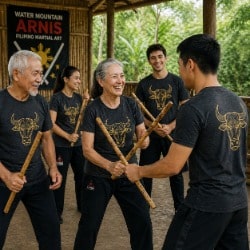
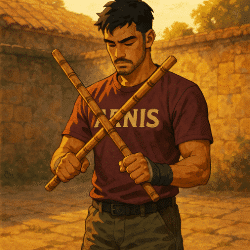
Older and younger martial artists practicing Arnis stick drills together while wearing shirts with a carabao logo.

Introduction

Arnis, a Filipino martial art known for its weapon-based movement, reflex drills, and coordination training, can help older adults preserve balance, mobility, reaction time, and cognitive engagement as they age. Because it combines physical movement with mental challenge, Arnis offers benefits that overlap with fall prevention, functional fitness, and healthy aging strategies.

Aging has a way of sneaking up on people.

It rarely arrives all at once. More often, it shows up in small moments. You hesitate a little longer stepping off a curb. Your balance feels less certain when turning too quickly. Your hands don’t respond as fast when something slips. Your body still works—but the margin for error gets thinner.

Most people write this off as “just getting older.”

And some of it is.

The body changes with age. Muscle mass gradually declines. Reflexes slow. Joints stiffen. Balance can become less reliable. Even the brain may process movement and reaction more slowly than it once did.

But here’s the part many people don’t hear often enough: decline is not always a straight line.

According to the National Institute on Aging and the Centers for Disease Control and Prevention, regular physical activity, balance-focused exercise, and coordination training can help older adults maintain independence, reduce fall risk, and preserve quality of life.

That brings us to Arnis.

Arnis—sometimes called Eskrima or Kali—is a Filipino martial art known for sticks, blades, and fast hand movements. To the untrained eye, it may seem like a young person’s game. Fast. Aggressive. Demanding.

But look closer.

Beneath the sticks and drills is a system that trains many of the exact qualities aging tends to erode: balance, coordination, reflexes, mobility, grip strength, mental engagement, and stress resilience.

In other words, Arnis may offer more than self-defense.

It may be a practical tool for healthy aging.

At Water Mountain, we’ve trained students in middle age and well into retirement. Many do not come to become fighters. They come because they want to remain capable.

They want to move with confidence.

They want to stay sharp.

They want to keep living on their own terms.

And in many cases, they do.

Why Balance and Coordination Decline With Age

Balance is not controlled by one thing.

It depends on strength, vision, inner-ear function, joint mobility, proprioception, and the nervous system’s ability to process and respond to movement.

Proprioception is your body’s sense of where it is in space. It helps you catch yourself when you trip, stabilize when you pivot, and move confidently over uneven ground.

As people age, proprioception often declines.

So does muscle mass.

A condition called sarcopenia—the gradual loss of muscle and strength with age—can reduce lower-body stability and make recovery from a stumble harder.

Reaction time often slows as well.

And slower reaction time can turn a small misstep into a serious fall.

That matters because falls are one of the leading causes of injury-related hospitalization among older adults, according to the CDC.

This is why “exercise” alone is not always enough.

Walking helps.

Strength training helps.

Stretching helps.

But preventing falls often requires more than strength. It requires the ability to adapt in motion.

That’s where Arnis stands out.

How Arnis Trains Real-World Balance

Many fitness programs train balance in controlled conditions.

Standing on one leg.

Holding a yoga pose.

Walking a straight line.

These have value.

But real-world balance rarely fails in controlled conditions.

People lose balance while turning quickly, stepping awkwardly, reaching for something, or reacting under stress.

Arnis trains movement under changing conditions.

Most systems use angular footwork patterns—triangular stepping, lateral movement, diagonal retreating, and pivoting. Practitioners learn to shift weight quickly while maintaining posture and awareness.

This challenges the body to stabilize dynamically.

Over time, these drills can improve the systems associated with balance and fall prevention.

Every drill asks the same question in a different way:

Where is your center?

Where are your feet?

Where is the incoming line?

Where do you move next?

That constant demand trains proprioceptive awareness and the neurological systems associated with dynamic balance.

And confidence matters.

People who fear falling often move stiffly or hesitantly. Ironically, that hesitation can increase fall risk.

People who trust their movement often move more naturally and recover faster.

Arnis practitioner honoring Filipino martial arts heritage

Carry the Lineage Forward

From the villages of Luzon to the rhythm of the modern world, the art of Arnis endures—grace in motion, history in every strike. The Water Mountain Arnis Collection honors that lineage with apparel inspired by the forms, spirit, and brotherhood of Filipino martial arts. Wear what you train. Remember where it began.

Explore the Arnis Collection

Arnis Improves Coordination and Reflexes

Coordination is more than looking graceful.

It is the ability to synchronize multiple systems at once.

Your eyes track movement.

Your brain processes it.

Your body responds.

Your feet reposition.

Your hands act.

All in fractions of a second.

Arnis trains this continuously.

A practitioner may strike with one hand while stepping in another direction and preparing the opposite hand to defend.

That kind of bilateral and cross-lateral movement challenges both sides of the body and may improve communication between both hemispheres of the brain.

Hand-eye coordination improves through timing drills and target-based striking.

Reaction speed improves through partner drills that create repeated stimulus-response cycles.

A line comes in.

You recognize it.

You react.

This kind of training can carry into everyday life.

Recovering from a stumble.

Catching a dropped object.

Navigating uneven terrain.

Responding more quickly behind the wheel.

These things matter more with age.

Cognitive Engagement and Brain Health

Research indexed in the National Institutes of Health database has found that martial arts-based exercise may improve balance, gait, and aspects of cognitive performance in older adults.

Healthy aging is not just physical.

Many people fear losing mental sharpness as much as physical ability.

Neuroplasticity is the brain’s ability to adapt, reorganize, and form new connections.

Arnis constantly challenges this system.

Students memorize combinations.

Recognize angles.

Adjust timing.

Read patterns.

Make decisions while moving.

This is not mindless exercise.

It is movement-based problem solving.

More research specific to Arnis would be valuable, but the overlap is clear.

Functional Strength and Joint Resilience

In our previous article on grip strength and joint resilience, we discussed how important practical strength becomes with age.

Arnis naturally supports many of those same systems.

Controlled stick drills repeatedly engage the hands, wrists, forearms, shoulders, and upper back.

This can improve grip endurance, wrist stability, shoulder mobility, and muscular coordination.

Unlike some forms of resistance training that emphasize movement in a single plane, stick work often creates rotational and multi-angle loading.

That can support more functional movement patterns.

Done properly, it can be joint-friendly and scalable.

Stress Regulation and Emotional Resilience

Stress ages people.

Chronic stress contributes to inflammation, poor sleep, slower recovery, and mood disruption.

Exercise helps regulate stress.

So does rhythm.

So does social interaction.

Arnis combines all three.

There is a meditative quality in repetitive flow drills.

There is emotional regulation in focused movement.

And there is psychological benefit in community.

Social isolation is associated with poorer health outcomes in older adults.

Training environments often provide accountability, belonging, and support.

That may not sound like “fitness.”

But it matters.

How Arnis Supports Healthy Aging

Arnis can support healthy aging by improving balance, coordination, reaction time, mobility, grip strength, cognitive engagement, and confidence in movement. It may also reduce fall risk, support stress management, and help preserve functional independence.

Benefits of Arnis for Healthy Aging

For older adults, Arnis may help support healthy aging by improving balance, coordination, reaction time, mobility, grip strength, cognitive engagement, and confidence in movement.

It may also help reduce fall risk, support stress management, and preserve functional independence.

That makes it broader than many single-purpose exercise programs.

And because it remains mentally engaging, people often stick with it longer.

Consistency matters.

Is Arnis Safe for Older Adults?

In many cases, yes.

When taught by a qualified instructor, Arnis can be adapted to age, mobility, and fitness level.

Older adults often begin with light sticks, slower drills, simple footwork, and non-contact exercises focused on coordination and mobility.

They do not need to spar.

They do not need flashy spins.

They simply need to move.

Older adults with existing injuries, neurological disorders, cardiovascular conditions, or significant balance issues should consult a qualified healthcare provider before beginning any new exercise or martial arts program.

Final Thoughts

Healthy aging is not just about adding years.

It is about preserving capability.

Can you move well?

Can you think clearly?

Can you recover when life knocks you off balance?

Arnis offers a unique combination of movement, reflex training, mental engagement, functional strength, and stress regulation that may help support those goals.

It is not a cure-all.

It is not magic.

But as part of a smart wellness strategy, it may help people stay steady, sharp, and capable longer.

And for many people, that may be the real definition of longevity.

Sources & References

The following sources informed this article’s discussion of healthy aging, fall prevention, physical activity, balance, and cognitive health:

  • Centers for Disease Control and Prevention — Older Adult Fall Prevention resources
  • National Institute on Aging — Exercise and Physical Activity guidance for older adults
  • National Institutes of Health / PubMed — Research on martial arts-based exercise, balance, gait, and cognitive function in older adults
  • World Health Organization — Physical activity recommendations for older adults
  • Mayo Clinic — Healthy aging, mobility, and exercise guidance

This article is for educational purposes only and is not a substitute for medical advice, diagnosis, or treatment. Older adults with existing injuries, cardiovascular concerns, neurological disorders, or significant balance problems should consult a qualified healthcare provider before beginning any new exercise or martial arts program.

Frequently Asked Questions About Arnis for Healthy Aging

Is Arnis good for older adults?

Yes, Arnis can be a good form of exercise for many older adults when taught safely. It trains balance, coordination, reaction time, grip strength, mobility, and mental focus, all of which support healthy aging.

Can Arnis help with balance and fall prevention?

Arnis may help with balance by training footwork, weight shifting, posture, and proprioception. These skills are closely related to fall prevention, especially because real-world balance often requires quick adjustment while moving.

Do seniors need martial arts experience to start Arnis?

No. Older adults can begin Arnis with basic footwork, light stick drills, and slow coordination exercises. A qualified instructor can adapt the training to the student’s age, fitness level, and mobility.

Is Arnis hard on the joints?

Arnis can be joint-friendly when practiced with proper instruction, light equipment, and controlled movement. Older students should avoid excessive speed, impact, or repetitive strain, especially if they have arthritis or prior injuries.

Can Arnis support brain health?

Arnis requires memory, timing, pattern recognition, and decision-making while moving. These qualities make it mentally engaging and may support cognitive resilience as part of a broader healthy aging routine.

Should older adults talk to a doctor before starting Arnis?

Older adults with cardiovascular conditions, neurological disorders, balance problems, joint pain, or recent injuries should consult a qualified healthcare provider before beginning Arnis or any new exercise program.
Leave a Reply