Flagstaff, AZ USA

Arnis and Gym Conditioning for Long-Term Health | Strength, Mobility & Aging

Arnis and gym conditioning are often framed as opposing approaches to fitness—but for long-term health, the smartest path may combine both. This article explores how Filipino Martial Arts can improve coordination, movement variability, balance, and cognitive engagement, while strength training supports muscle retention, bone health, and structural resilience as we age.
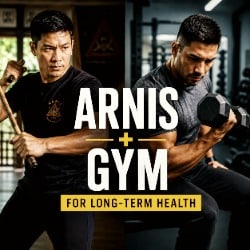
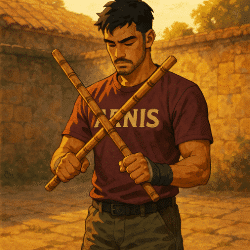
Arnis practitioner and gym athlete shown side-by-side representing complementary approaches to long-term health, strength, mobility, and conditioning.

Why Smart Martial Artists Often Benefit From Both

There’s a quiet argument that shows up in martial arts circles every few years.

One side says modern gym training is artificial, isolating, and disconnected from real human movement. The other side argues that martial artists who ignore strength training eventually pay for it with weaker bones, declining muscle mass, and chronic injury.

The truth is more useful—and a lot less dramatic.

For long-term health, mobility, and sustainable physical performance, Arnis and gym conditioning are often complementary rather than competitive.

That matters because many people searching for Filipino Martial Arts today are not twenty-year-old fighters preparing for tournaments. They are adults trying to stay capable, coordinated, and physically independent as they age. Some are recovering from stress-heavy careers. Others are rebuilding after years of inactivity. Quite a few are former athletes trying to move well again without feeling broken afterward.

In that environment, the real question is not:

“Which is superior?”

It is:

“What kind of conditioning helps a person remain physically functional, adaptable, and resilient over decades?”

That is where the comparison becomes genuinely interesting.

The Difference Between Training Muscles and Training Movement

Modern gym conditioning is excellent at one thing: Progressive mechanical loading.

That sounds technical, but it simply means gradually placing controlled stress on muscles, bones, and connective tissue so the body adapts over time.

Resistance training has strong research support for:

  • Preserving muscle mass during aging
  • Supporting bone density
  • Improving insulin sensitivity
  • Enhancing metabolic health
  • Maintaining strength and power later in life


This is one reason organizations like the National Institute on Aging and the Centers for Disease Control and Prevention encourage resistance training as part of healthy aging strategies.

But gyms also tend to create predictable movement environments.

Machines move in fixed paths.
Exercises are segmented.
Patterns are repeated in highly controlled ways.

There is nothing inherently wrong with that. In fact, for rehabilitation and targeted strength development, it can be extremely valuable.

Arnis training develops something different.

It emphasizes:

  • Coordination under movement
  • Bilateral integration
  • Timing and rhythm
  • Rotational mechanics
  • Footwork adaptability
  • Reaction speed
  • Hand-eye integration
  • Multi-directional movement variability

Instead of isolating movement, Arnis tends to connect movement.

A practitioner may shift angles, rotate through the hips, coordinate upper and lower body timing, adjust stance dynamically, and process visual information simultaneously—all while managing a training partner.

That creates a very different conditioning effect than simply pressing weight through a fixed plane.

Why Movement Variability Matters More With Age

One of the least discussed aspects of long-term fitness is movement variability.

Many overuse injuries come not from movement itself, but from repeating the same movement pattern without enough variation.

This is true in sports.
It is true in manual labor.
It is also true in the gym.

A person who only benches, squats, rows, and curls for years may become strong in specific patterns while losing adaptability elsewhere.

Arnis naturally introduces variation.

Even basic drills often involve:

  • Direction changes
  • Shifting ranges
  • Dynamic stepping
  • Rotational loading
  • Cross-body coordination
  • Unpredictable timing


That kind of training may help preserve neuromuscular adaptability later in life.

In plain English: The body stays practiced at adjusting.

That becomes increasingly important as people age because falls, missteps, and awkward real-world movements rarely happen in clean, predictable lines.

A slippery floor. A missed stair. A sudden pivot while carrying groceries.

These situations demand coordination, reaction, balance, and body awareness—not just isolated strength.

Arnis and Cognitive Longevity

Another interesting difference between martial arts conditioning and conventional gym work is cognitive engagement.

Many gym exercises become highly automatic over time.

Arnis usually does not.

Even repetitive drills often require:

  • Pattern recognition
  • Timing decisions
  • Spatial judgment
  • Partner interaction
  • Rhythm adaptation
  • Attention management


Research into aging increasingly suggests that combining physical movement with cognitive engagement may support healthier brain aging more effectively than passive movement alone.

This does not mean Arnis “prevents dementia” or replaces medical intervention. Claims like that would go far beyond current evidence.

But it does suggest why many older practitioners report feeling mentally sharper and more engaged when practicing movement systems that demand active coordination and decision-making.

The training keeps the nervous system involved.

The Gym Still Solves Problems Arnis Does Not

This is where many martial arts articles become unrealistic.

A person who only practices flow drills and light stick work may still lack:

  • Sufficient muscular strength
  • Bone-loading stimulus
  • Posterior chain development
  • Progressive overload
  • Grip strength balance
  • Structural stability

And aging changes the equation.

After roughly age 30, adults gradually lose muscle mass unless they actively maintain it. Bone density also becomes increasingly important, especially later in life.

Well-designed resistance training directly addresses those concerns.

That is why the healthiest long-term approach for many practitioners is not: “Arnis instead of the gym.”

It is: “Arnis plus intelligent strength work.”

Even two brief weekly strength sessions can meaningfully support:

  • Joint stability
  • Tendon resilience
  • Fall resistance
  • Bone health
  • Recovery capacity
  • Longevity of martial arts practice itself


In many cases, proper conditioning allows people to continue practicing martial arts longer with fewer setbacks.

Why Arnis Is Often Easier to Sustain Than Heavy Athletic Training

One overlooked advantage of Filipino Martial Arts is scalability.

Many sports become harder to sustain with age because they rely heavily on:

  • Impact
  • Collision
  • Maximal force production
  • Extreme conditioning demands

Arnis can be adapted across intensity levels.

Training may emphasize:

  • Light flow work
  • Timing drills
  • Controlled partner interaction
  • Footwork
  • Coordination development
  • Technical sequencing


Older practitioners can still train meaningfully without requiring the same recovery demands seen in combat sports centered around hard sparring or explosive athleticism.

That makes Arnis unusually compatible with longevity-oriented training.

For many people, it becomes less about proving toughness and more about maintaining capability.

The Real Goal Is Capacity Across Decades

One problem with modern fitness culture is that it often confuses peak performance with sustainable health.

They overlap—but they are not identical.

A twenty-five-year-old athlete can survive poor movement habits for quite a while.

A sixty-year-old usually cannot.

Long-term health is often built on:

  • Consistency
  • Adaptability
  • Joint preservation
  • Moderate strength
  • Balance
  • Recovery capacity
  • Sustainable movement habits


Arnis contributes strongly to several of those areas, particularly coordination, rhythm, mobility, and integrated movement.

Gym conditioning contributes strongly to others, particularly strength, bone loading, and muscular preservation.

Together, they create a more complete physical system.

A Smarter Framework for Martial Artists

Instead of asking whether Arnis is “better” than gym conditioning, a better question is:

“What physical qualities does each system develop well?”

Arnis develops:

  • Coordination
  • Reaction
  • Timing
  • Rhythm
  • Movement adaptability
  • Spatial awareness
  • Rotational mechanics
  • Cognitive-motor integration

Strength training develops:

  • Muscle retention
  • Bone density support
  • Force production
  • Structural stability
  • Progressive overload tolerance
  • Tissue resilience


Those qualities are not enemies. In many cases, they support each other. A stronger body can practice Arnis longer.
A more coordinated body often moves more efficiently under load.

That is why many experienced practitioners eventually stop treating martial arts and conditioning as separate worlds. They begin treating both as parts of long-term human maintenance.

Final Thoughts

The healthiest training systems are rarely the most ideological ones.

Arnis offers something modern fitness often lacks: adaptable movement, coordination under pressure, rhythmic integration, and sustainable skill-based activity that can continue deep into later life.

Gym conditioning offers something many martial artists eventually realize they still need: strength preservation, structural resilience, and measurable physical maintenance.

The smartest path for most people is not choosing one side.

It is learning how both systems can work together to support long-term health, capability, and quality of life.

Especially as the years pass, that balance matters far more than winning arguments about which style of conditioning is “best.”

Arnis practitioner honoring Filipino martial arts heritage

Carry the Lineage Forward

From the villages of Luzon to the rhythm of the modern world, the art of Arnis endures—grace in motion, history in every strike. The Water Mountain Arnis Collection honors that lineage with apparel inspired by the forms, spirit, and brotherhood of Filipino martial arts. Wear what you train. Remember where it began.

Explore the Arnis Collection

References & Resources

  • Centers for Disease Control and Prevention — Physical Activity Guidelines for Older Adults
    https://www.cdc.gov/physicalactivity/basics/older_adults/index.htm

  • National Institute on Aging — Exercise and Physical Activity for Healthy Aging
    https://www.nia.nih.gov/health/exercise-and-physical-activity

  • World Health Organization — Physical Activity and Sedentary Behaviour Guidelines
    https://www.who.int/news-room/fact-sheets/detail/physical-activity

  • Fragala MS, Cadore EL, Dorgo S, et al. Resistance Training for Older Adults: Position Statement From the National Strength and Conditioning Association. Journal of Strength and Conditioning Research. 2019.

  • American College of Sports Medicine. ACSM’s Guidelines for Exercise Testing and Prescription.

  • Granacher U, Muehlbauer T, Gollhofer A, et al. Effects of balance training on postural control in older adults. Sports Medicine. 2011.

  • Ratey JJ. Spark: The Revolutionary New Science of Exercise and the Brain. Little, Brown and Company.

Important Note

This article is intended for educational and informational purposes only and should not be considered medical advice. Individuals with injuries, chronic health conditions, balance disorders, or cardiovascular concerns should consult a qualified healthcare professional before beginning a new martial arts or conditioning program.

Frequently Asked Questions

Can Arnis replace going to the gym?

For most people, Arnis should complement gym conditioning rather than replace it. Arnis supports coordination, timing, mobility, balance, and movement adaptability, while strength training is especially useful for maintaining muscle, bone health, and structural resilience.

Is Arnis good exercise for long-term health?

Yes, Arnis can be a strong long-term movement practice when taught safely and scaled appropriately. It encourages whole-body coordination, footwork, rhythm, reaction, and mental engagement, all of which can support functional movement as people age.

Why is strength training still important for martial artists?

Strength training helps preserve muscle mass, support bone density, improve joint stability, and build the physical reserve needed for healthy aging. For martial artists, this can make training more sustainable and reduce the risk of avoidable strain.

Does Arnis help with balance and coordination?

Arnis often includes footwork, hand-eye coordination, rhythm changes, angle changes, and partner interaction. These features can help practitioners develop better body awareness and coordination, especially when training is progressive and not rushed.

Is Arnis safe for older adults?

Arnis can be adapted for many older adults, especially when training focuses on controlled movement, light equipment, proper pacing, and good instruction. People with injuries, balance issues, or chronic health conditions should consult a qualified healthcare professional before beginning.

What is the best approach for longevity: Arnis or gym conditioning?

The best approach is usually a combination. Arnis develops movement skill, coordination, adaptability, and cognitive engagement, while gym conditioning develops strength, tissue resilience, and bone-supporting mechanical loading. Together, they create a more complete long-term health strategy.

Leave a Reply