Stir-Fried Bok Choy for Liver Qi: A Simple Spring Recipe
A simple stir-fried bok choy recipe for spring. Light, easy to digest, and ideal for supporting liver qi and Qi Gong practice.
Flagstaff, AZ USA
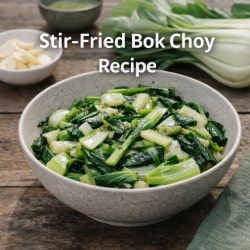
Spring is supposed to feel like movement.
Energy rises. The body opens. Practice becomes smoother, or at least it should.
But that’s not always how it plays out.
Instead, some people feel tight. Irritable. Stuck in a way that’s hard to explain. The body wants to move, but something isn’t lining up.
In traditional Chinese medicine, this is often described as a disruption in the smooth flow of Liver qi.
That doesn’t mean something is “wrong” in a clinical sense. It means the natural direction of the season isn’t being fully supported.
Qi Gong works directly on that movement.
Diet either helps—or gets in the way.
Spring eating tends to move in a specific direction.
Lighter foods. Fresher ingredients. Less density, more movement.
Leafy greens sit right at the center of that shift.
Not because they’re trendy or labeled as “superfoods,” but because they match the season. They’re light, quick to digest, and naturally aligned with growth and upward movement.
Bok choy is one of the simplest ways to bring that into your diet.
It cooks quickly. It doesn’t need much added to it. And it supports the kind of meals that leave you feeling clear rather than weighed down.
That’s what matters in spring.
In TCM, the Liver system is associated with:
When that system is supported, movement feels easier. Not just in Qi Gong, but in daily life.
When it isn’t, the signs are usually subtle at first:
Leafy greens are often used as part of the dietary side of that equation.
Not as a fix. Just as support.
This is where simplicity matters.
The goal isn’t to build a complex dish. It’s to keep the food light and usable.
That’s it.
No heavy sauces. No layering of flavors that turns it into something dense.
Just enough to make it usable.
This isn’t meant to be the center of every meal.
It works best as a supporting piece.
It’s flexible. That’s part of its value.
Spring eating isn’t about strict plans. It’s about consistency over time.
The mistake isn’t eating greens.
It’s overdoing them—or overcomplicating them.
Heavy sauces, excessive oil, or turning a simple dish into something rich can undo the benefit.
The other mistake is relying too heavily on raw foods.
While raw greens have their place, lightly cooked vegetables are often easier to digest, especially early in the season.
Again, the goal isn’t intensity.
It’s alignment.
When this kind of food becomes part of your routine, the changes are subtle but consistent.
Movement feels smoother.
Stretching meets less resistance.
Breath settles more easily.
There’s less friction overall.
That’s the point.
Not dramatic change—just less resistance.
Spring doesn’t ask for complexity.
It asks for movement.
Sometimes the most effective change is the simplest one—something you can make, repeat, and actually use.
A pan, a handful of greens, and a few minutes is often enough.
Bok choy is a light, leafy green that aligns with the upward and outward movement of spring. It fits well within seasonal eating patterns that support smooth energy and digestion.
Leafy greens are commonly used in traditional Chinese dietary practice to support the smooth flow of qi. Bok choy, being light and easy to prepare, is often included as part of that seasonal approach.
Lightly cooked bok choy is generally easier to digest, especially during seasonal transitions. Cooking softens the fibers while keeping the dish light and supportive.
It works best as part of a midday or early evening meal, when digestion is active but lighter foods are still preferred.
You can, but keeping the dish simple is often more effective for spring eating. Heavy sauces or excess oil can reduce the light, clean quality that makes it beneficial.
Qi Gong and the Spring Diet: Eat with the Season
Mung Bean Soup for Spring Qi: A Simple Seasonal Reset
Stir-Fried Bok Choy for Liver Qi: A Simple Spring Recipe
Warm Lemon Drink for Spring Qi: A Simple Morning Reset
Spring Barley Porridge: A Gentle Grain for Rising Qi
Qi Gong and Nutrition: How Food Fuels Energy, Balance, and Longevity
Geography and Qi Gong Diets: How Climate and Location Shape Energetic Nutrition
Qi Gong Diets for Arid and High-Desert Regions
What Is Qi Gong? A Beginner’s Guide to Energy Healing
Buddhism, Vegetarianism, and Qi Gong: How Buddhist Diets Shaped East Asian Qi Gong Traditions
Qi Gong and Confucian Moderation: The Art of Balance in Practice and Life
Qi Gong and Autumn Eating: Roots, Grains, and Seasonal Transition
Taoist Winter Warming Bowl Recipe for Qi Gong Practice
Break the Stress Anxiety Cycle With Qi Gong and Nutrition
Qi Gong and Digestive Health: Strengthening the Middle Burner