Flagstaff, AZ USA

Stress Regulation Through Arnis Training

Arnis doesn’t avoid stress—it trains it. Through patterned striking, rhythm, and focused weapon work, practitioners learn to stay calm and functional under pressure. This article explores how Arnis naturally regulates the nervous system, reduces mental rumination, and turns stress into a trainable skill rather than something to escape.
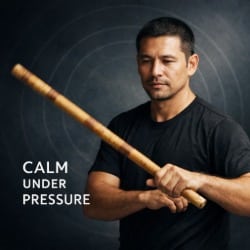
Arnis practitioner holding a rattan stick with calm focus, illustrating stress regulation through rhythmic martial arts training.

How patterned weapon work trains the nervous system under pressure

Most people talk about stress as something to be reduced.

Arnis—whether people realize it or not—treats stress as something to be trained, regulated, and released.

That difference matters.

Modern wellness culture often frames stress as an external toxin: too much cortisol, too much stimulation, too many demands. Martial arts culture, on the other hand, tends to talk around stress—using words like discipline, toughness, or grit—without ever explaining what’s actually happening inside the body.

Arnis sits quietly in the middle, doing something most systems don’t articulate:

It exposes the nervous system to pressure in a controlled, patterned way, then teaches it how to stay functional inside that pressure.

That’s not accidental. It’s built into the structure of the art.

Patterned Striking as Regulated Stress Exposure

From the outside, Arnis looks fast and chaotic—sticks moving, angles flashing, exchanges happening at speed.

Internally, it’s the opposite.

Most Arnis training revolves around repeating strike patterns: angles, combinations, flows, and counters practiced thousands of times. This repetition does more than build coordination—it creates a predictable stress environment.

Here’s why that matters:

  • The nervous system responds strongly to unpredictability

  • Repetition introduces stress without chaos

  • The practitioner stays engaged, alert, and physical—without panic

This is what psychologists call regulated exposure. The body experiences elevated arousal—movement, speed, intent—but within a known framework.

You’re not avoiding stress.
You’re learning to operate inside it.

That’s a very different adaptation than simply trying to calm down.

Rhythm, Timing, and Breath Under Pressure

One of the most underappreciated features of Arnis is rhythm.

Every pattern has timing. Every exchange has cadence. Even free-flow drills tend to settle into a pulse—strike, recover, move, respond.

This rhythmic structure quietly entrains the breath.

Most practitioners don’t consciously think about breathing during drills, but something happens anyway:

  • Breath syncs to motion

  • Exhalations align with strikes

  • Inhales occur during recovery beats

That’s not mystical—it’s mechanical.

When breathing becomes rhythmically linked to movement, the nervous system receives a steady signal: this is effort, not emergency. Over time, that reduces the tendency to spike into fight-or-flight during pressure.

This is why experienced Arnis practitioners often appear calm even when training fast or hard.
Their breathing never fully disconnects.

They stay inside effort without tipping into overwhelm.

Weapon Focus and the Reduction of Mental Rumination

Stress isn’t just physical—it’s cognitive.

A large portion of modern stress comes from rumination: looping thoughts, unresolved worries, internal narration that never shuts off.

Weapon training interrupts that loop.

When you’re holding a stick and tracking angles, distance, timing, and opponent movement, your attention narrows naturally. There’s no room for background noise.

This kind of focus does three things at once:

  • It pulls attention out of abstract worry

  • It anchors awareness in the body

  • It demands present-moment decision making

Unlike seated meditation, this focus is active. The mind isn’t told to be quiet—it’s given something non-negotiable to do.

For many people—especially those who struggle with traditional mindfulness—this is far more effective.

The stick doesn’t allow rumination.
It requires presence.

Stress Is Not Avoided; It’s Cycled

A critical mistake in many wellness approaches is the idea that stress should be eliminated.

The body doesn’t work that way.

Healthy nervous systems cycle between activation and recovery. Problems arise when activation never resolves, or when recovery never happens.

Arnis naturally trains this cycle:

  • Engagement → strike → movement

  • Pause → reset → pattern restart

  • Pressure → release → repetition

Each drill creates a small stress arc, followed by resolution. Over time, the body learns that activation ends. That knowledge alone reduces baseline anxiety.

You’re not stuck in stress.
You move through it.

That’s regulation.

Why This Matters in a Trauma-Aware Context

Modern trauma research emphasizes something important: regulation happens through experience, not explanation.

You can’t talk your nervous system into safety.

Arnis provides:

  • Predictable structure

  • Clear boundaries

  • Progressive intensity

  • Immediate feedback

This makes it unusually compatible with trauma-aware training models, even though the art itself predates those frameworks by centuries.

Practitioners learn to tolerate speed, contact, and pressure without dissociation or shutdown—not because they’re forcing toughness, but because the system ramps stress gradually and rhythmically.

That’s regulation in action.

Arnis as Functional Stress Training

When framed this way, Arnis isn’t just a martial art.

It’s functional stress training.

  • Physical stress that doesn’t overwhelm

  • Cognitive focus that interrupts rumination

  • Rhythmic movement that regulates breath

  • Repetition that builds confidence under pressure

This is why stress relief shows up as a side effect of consistent training—even when no one is explicitly talking about stress at all.

The body figures it out.

Why This Topic Has Been Missed

Wellness articles tend to stay abstract: breathing exercises, relaxation techniques, mindset shifts.

Martial arts articles tend to stay technical: techniques, drills, history, sparring.

Very few explain how stress is trained and released inside the practice itself.

That’s the gap this article fills.

And it’s a gap search engines notice—because it maps a physical process to a measurable mental outcome in a way that’s clear, concrete, and repeatable.

Arnis practitioner honoring Filipino martial arts heritage

Carry the Lineage Forward

From the villages of Luzon to the rhythm of the modern world, the art of Arnis endures—grace in motion, history in every strike. The Water Mountain Arnis Collection honors that lineage with apparel inspired by the forms, spirit, and brotherhood of Filipino martial arts. Wear what you train. Remember where it began.

Explore the Arnis Collection

Sources & References

Stress, Nervous System Regulation, and Rhythmic Movement

  • Porges, S. W. (2011). The Polyvagal Theory: Neurophysiological Foundations of Emotions, Attachment, Communication, and Self-Regulation. W. W. Norton & Company.
    (Foundational work on autonomic regulation and how patterned activity influences stress response.)

  • van der Kolk, B. (2014). The Body Keeps the Score: Brain, Mind, and Body in the Healing of Trauma. Viking.
    (Establishes that regulation occurs through embodied experience rather than cognition alone.)

  • Thayer, J. F., & Lane, R. D. (2009). “Claude Bernard and the Heart–Brain Connection: Further Elaboration of a Model of Neurovisceral Integration.” Neuroscience & Biobehavioral Reviews.
    (Explains how rhythmic activity and breath influence nervous system flexibility.)

Patterned Movement, Skill Learning, and Stress Tolerance

  • Schmidt, R. A., & Lee, T. D. (2019). Motor Learning and Performance. Human Kinetics.
    (Demonstrates how repetition and pattern learning reduce cognitive load under pressure.)

  • Ericsson, K. A., & Pool, R. (2016). Peak: Secrets from the New Science of Expertise. Houghton Mifflin Harcourt.
    (Supports the role of structured repetition in developing calm performance under stress.)

Attention, Rumination, and Task-Focused Training

  • Killingsworth, M. A., & Gilbert, D. T. (2010). “A Wandering Mind Is an Unhappy Mind.” Science.
    (Shows the psychological cost of rumination and mind-wandering.)

  • Tang, Y.-Y., Hölzel, B. K., & Posner, M. I. (2015). “The Neuroscience of Mindfulness Meditation.” Nature Reviews Neuroscience.
    (Provides comparison context for active vs. passive attention regulation.)

Martial Arts, Combat Sports, and Psychological Regulation

  • Woodward, T. W. (2009). “A Review of the Effects of Martial Arts Practice on Health.” British Journal of Sports Medicine.
    (Reviews psychological and stress-related benefits of martial arts training.)

  • Vertonghen, J., & Theeboom, M. (2010). “The Social-Psychological Outcomes of Martial Arts Practise Among Youth.” Journal of Sports Science & Medicine.
    (Supports claims about confidence, emotional regulation, and stress tolerance.)

Breathing, Rhythm, and Autonomic Balance

  • Lehrer, P. M., Vaschillo, E., & Vaschillo, B. (2000). “Resonant Frequency Biofeedback Training to Increase Cardiac Variability.” Applied Psychophysiology and Biofeedback.
    (Explains how rhythmic breathing and movement support nervous system balance.)

How This Article Uses These Sources

This article does not claim that Arnis was designed using modern neuroscience. Instead, it shows how long-standing training structures in Arnis align with well-documented principles of stress regulation, motor learning, and nervous system adaptation.

The conclusions here are drawn from synthesis—not speculation.

Stress Regulation Through Arnis Training – FAQs

How does Arnis help with stress regulation?

Arnis helps regulate stress by exposing the nervous system to pressure in a structured, repeatable way. Patterned striking, rhythm, and focused movement allow practitioners to experience stress without becoming overwhelmed, teaching the body how to return to a calm, functional state after activation.

Is Arnis meant to reduce stress or train it?

Arnis does not aim to eliminate stress. Instead, it trains the body and mind to operate calmly within stress. Through repeated drills and controlled intensity, practitioners learn that activation is temporary and manageable, which naturally lowers baseline stress over time.

Why does repetitive stick training feel calming?

Repetition reduces uncertainty. When the body recognizes familiar movement patterns, cognitive load decreases and attention shifts from rumination to present-moment action. This combination of predictability and focus helps calm the nervous system.

Does Arnis involve breathing techniques for stress?

While Arnis does not typically teach formal breathing exercises, breathing often synchronizes naturally with movement and rhythm during training. Over time, this creates smoother breathing patterns under pressure, supporting nervous system regulation.

How does weapon training affect mental focus?

Weapon training demands continuous attention to timing, distance, and coordination. This level of focus leaves little room for mental rumination, helping interrupt stress-related thought loops and anchoring attention in the body and the present moment.

Is Arnis suitable for people interested in wellness, not just combat?

Yes. Many people practice Arnis for coordination, focus, and stress regulation rather than self-defense alone. Its structured drills and rhythmic movement make it accessible to those seeking functional wellness benefits alongside physical skill development.

How is Arnis different from meditation for stress relief?

Meditation often works by quieting the mind through stillness. Arnis works through active engagement, using movement and focus to naturally organize attention and regulate stress. For some people, this active approach is easier to sustain than seated practices.
Leave a Reply