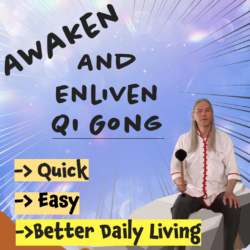
Winter Qi Gong Report-2025
Quick Study Guide and Summary
The talk is recorded at the winter solstice, marking entry into the stable winter yin phase, which lasts several weeks and represents the most energetically stable yin period of the year.
One consistent challenge of winter is cold qi, which is related to but distinct from physical cold.
Cold qi is described as a penetrating cold that can sink into the body, affecting the bones, joints, core, and even mental clarity.
Cold qi can be present even when temperatures are not extremely low, and its effects are felt subjectively rather than measured by temperature alone.
A small amount of cold qi exposure is not harmful and may help maintain adaptability in the qi system.
Problems arise when cold qi overwhelms the body’s ability to process it, causing lingering cold sensations, pain, or stiffness that persist for days.
Recovery from excessive cold qi occurs naturally through exposure to yang, particularly heat and fire.
Many cultures in cold climates have developed warming beverages to counteract cold qi.
A simple warming beverage formula is presented using citrus (orange juice or peel), ginger, and cinnamon, optionally combined with wine to improve absorption and speed warming effects.
The mixture is simmered and reduced, then consumed in moderation to restore warmth without overheating the body.
Maintaining a balanced yin–yang state supports health and longevity.
Cold qi becomes more problematic with age or inactivity, as natural yang declines and the body’s ability to counter cold is reduced.
For older individuals, cold qi can contribute to joint pain, swelling, and arthritic conditions, making warming strategies more important during winter.
Carry your practice beyond the mat.
The Refined Qi Gong Collection blends stillness and style — inspired by the same principles you train with.
Does Master Steenrod Know What He’s Talking About?
Winter, Cold Qi, and What the Old Texts Actually Say
By Hal Winthrop
When a modern teacher uses terms like cold qi, the first question isn’t whether the language sounds scientific enough. The real question is simpler—and more honest:
Is this what the tradition itself actually teaches?
In his 2025 Winter Qi Gong Report, Master Mikel Steenrod describes winter as a period of stable yin, warns about the effects of cold qi, and recommends warmth, moderation, and recovery rather than intensity. None of this is flashy. None of it is extreme. And that’s precisely why it deserves closer examination.
Because when we compare his claims to classical Chinese medical sources, something interesting happens: the overlap is almost exact.
Winter as Storage, Not Struggle
Steenrod opens by situating winter around the solstice and describing it as the most stable yin period of the year. This isn’t poetic framing—it’s classical seasonal doctrine.
In the Huangdi Neijing, winter is associated with storage, containment, and stillness. The Suwen repeatedly warns that excessive activity during winter damages the kidneys and shortens vitality. Health during this season isn’t about doing more—it’s about preserving what remains.
Steenrod’s emphasis on winter as a window of stability rather than a hardship aligns directly with this view. He doesn’t portray winter as dangerous by default. He presents it as revealing—clear, honest, and unforgiving of excess.
That’s not a modern reinterpretation. That’s classical medicine.
Cold Qi: Penetrating, Contracting, Persistent
One of the more misunderstood concepts in Chinese medicine is cold. Steenrod is careful to separate physical temperature from cold qi, describing the latter as a cold that sinks, lingers, and affects joints, bones, and even mental clarity.
This description mirrors the classical category of Han (Cold) within the Six External Pathogens (Liu Yin). In traditional medical texts, cold is said to contract tissues, slow circulation, and lodge deeply when unresolved. Chronic cold is often described as entering the joints or even the bones—language Steenrod echoes almost verbatim.
Importantly, classical medicine never claims cold is always harmful. Cold becomes a problem only when it overwhelms upright qi—the body’s capacity to regulate and recover. Which brings us to one of Steenrod’s most understated but accurate points.
Stress Isn’t the Enemy—Overload Is
Steenrod notes that small amounts of cold exposure aren’t necessarily bad. In fact, variation helps maintain adaptability. Trouble begins when cold lingers for days and the body can’t clear it.
This maps cleanly onto the classical distinction between Zheng Qi (upright or healthy qi) and Xie Qi (pathogenic influence). Disease doesn’t occur simply because a pathogen is present. It occurs when exposure exceeds capacity.
Modern physiology would call this a stress–recovery imbalance. Classical medicine already had a name for it—and a remarkably similar model.
Aging, Yang Decline, and Cold Sensitivity
Another area where Steenrod stays firmly within classical bounds is aging. He explains that younger bodies handle cold more easily because they have more available yang. As we age—or become inactive—cold becomes harder to dispel and more likely to settle into joints.
This is straight out of the Neijing’s life-stage theory. Yang declines with age. Kidney fire weakens. Cold accumulates more easily. Joint pain and stiffness increase. None of this is controversial within Chinese medicine, and Steenrod avoids exaggeration or fear-based language.
He doesn’t claim cold causes arthritis. He notes that it can exacerbate what’s already there—a subtle but important distinction that keeps the advice grounded and responsible.
Warming the Body the Old-Fashioned Way
Steenrod’s practical recommendation—a simple warming beverage using citrus, ginger, cinnamon, and optional wine—is notable for what it doesn’t include. No exotic herbs. No rare formulas. No proprietary blend.
Each ingredient has a long history in the classical materia medica:
Ginger (Sheng Jiang) warms the middle and disperses cold
Cinnamon (Gui Zhi / Rou Gui) warms the channels and supports circulation
Citrus peel (Chen Pi) regulates qi and aids absorption
The use of fire and warmth as recovery tools is universal across cold-climate cultures, and Steenrod frames it that way. This isn’t esoteric medicine. It’s conservative, accessible, and intentionally moderate.
So—Does He Know What He’s Talking About?
When Master Steenrod talks about winter, cold qi, and the need for warmth and restraint, he isn’t modernizing the tradition or borrowing selectively from it. He’s repeating ideas that appear—sometimes almost word for word—in the earliest Chinese medical texts.
The language may sound unfamiliar to modern ears, but the logic is old, consistent, and notably restrained. There are no miracle claims here. No urgency. No pressure to intensify practice.
Just a clear seasonal principle: when the world contracts, the body must be supported—not forced.
By classical standards, that’s not just correct. It’s responsible.
Winter Qi Gong – Frequently Asked Questions
What is cold qi?
Cold qi refers to a penetrating quality of cold that can settle into the body, affecting joints, circulation, and clarity. It is related to—but not the same as—physical temperature.
Is cold qi always harmful?
No. Small amounts of cold exposure can help maintain adaptability. Problems arise when cold overwhelms the body’s ability to recover and lingers for days.
Why does winter affect joints and stiffness more?
Winter is a season of stable yin. For many people—especially as they age—reduced warmth and circulation can make it harder to resolve cold, leading to stiffness or discomfort in the joints.
How does Qi Gong help with cold qi?
Qi Gong supports internal regulation by strengthening circulation and balance. When the body’s regulatory systems are functioning well, it can naturally neutralize or release cold.
What can I do if I don’t practice Qi Gong?
Simple warming strategies—such as exposure to heat, fire, or warming beverages—can help support recovery when cold qi becomes excessive.
Are warming beverages safe to use regularly in winter?
When used in moderation, common warming ingredients like ginger, cinnamon, and citrus are traditionally used throughout winter. The key is balance—warming without overheating.
Does cold qi become more of an issue with age?
Yes. As natural warmth and activity levels decline with age, the body may have more difficulty resolving cold, making supportive strategies more important.
Is winter a good time to push harder in practice?
Winter generally favors restraint and precision rather than intensity. Doing less—but doing it correctly—supports stability and long-term health.
Related Articles
What Is Qi Gong? A Beginner’s Guide to Energy Healing
Qi Gong for Letting Go: The Practice of Plucking the Blossom
Types of Qi Gong: Medical, Martial, Spiritual and Healing Guide
Yin and Yang Explained: The Real Qi Connection
How Qi Gong Frees You From Burdens
How Qi Storage Affects Your Life