Flagstaff, AZ USA

Grip Strength and Joint Health in Arnis Training

Arnis training develops more than coordination. Through repeated stick flow, practitioners build grip endurance, rotational strength, and tendon resilience in the wrists, elbows, and shoulders. This article explains how skill-based weapon practice supports joint health through progressive, intelligent movement—without medical claims or heavy joint compression.

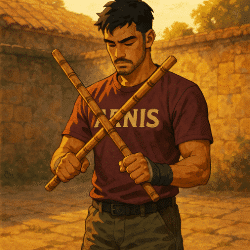
Older male Arnis practitioner with taped wrists holding a rattan baston while approaching his Filipino instructor during outdoor stick training.

Introduction

Why stick training builds resilient wrists, elbows, and shoulders

There’s a kind of fatigue that shows up after a solid Arnis session.

Not the kind you get from lifting heavy weights.
Not the kind you get from running.

It settles into the wrists. The forearms. The elbows.

It feels deep. Structural.

And if you train long enough, you start to realize something:

Arnis isn’t just building coordination.
It’s building connective tissue.

Let’s unpack that carefully.

Grip Strength: More Than Holding a Stick

When you first learn Arnis, you’re told not to squeeze too hard.

“Relax the grip.”

That instruction seems strange. If you want control, shouldn’t you grip tighter?

Actually, no.

Effective stick work requires a responsive grip — tightening only at impact, relaxing in motion, adjusting constantly.

What’s happening physiologically

Grip strength depends on coordinated activation of the finger flexors and extensors in the forearm. Research shows that grip strength is strongly associated with overall functional capacity, especially as people age (Bohannon, 2019; Celis-Morales et al., 2018).

Grip isn’t just about the hand. It reflects systemic strength and neuromuscular efficiency.

What that means in plain English

If your grip is strong and coordinated, you tend to handle daily tasks better — carrying groceries, opening jars, stabilizing yourself during a fall.

Arnis trains grip in motion.
Not by crushing something.
But by learning when to hold and when to let go.

That rhythm builds endurance without unnecessary strain.

Tendons Adapt Slowly — and Arnis Respects That

Muscles respond quickly to training. Tendons do not.

Tendons — the thick cords that attach muscle to bone — adapt through repeated, moderate loading over time (Magnusson et al., 2008; Bohm et al., 2015).

Heavy, sudden increases in load can irritate them.
Consistent, progressive exposure helps them remodel.

What’s happening in stick drills

Every strike involves acceleration — and more importantly — deceleration.

Stopping a strike requires the forearm and elbow stabilizers to absorb force.

That controlled slowing down is what conditions connective tissue.

What that means in plain English

When you practice strikes properly — relaxed, controlled, progressive — your wrists and elbows learn to handle force without stiffening.

You’re teaching your joints how to manage stress instead of locking against it.

That’s resilience.

Rotational Strength: The Missing Piece in Modern Training

Most gym exercises move straight forward or straight up.

Arnis moves in arcs.

Forehand. Backhand. Redirection. Flow.

That means the forearm cycles through:

  • Pronation (turning the palm down)

  • Supination (turning the palm up)

  • Subtle side-to-side deviations at the wrist

Why that matters

Joint stability depends on muscles working together across multiple planes of motion. Rotational loading improves coordination across those planes.

In simpler terms

Real life isn’t straight lines.

You twist to grab something.
You rotate to catch yourself.
You turn while carrying weight.

Arnis trains rotation safely and repeatedly — with a tool light enough to be manageable, but substantial enough to create adaptation.

Elbows: Strength Without Compression

A lot of elbow irritation in athletes comes from repetitive gripping combined with high compression or sudden force.

Arnis uses repetition — but not heavy compression.

The rattan stick weighs far less than a barbell.
The stress is more about control than load.

Physiologically speaking

Lower-load, higher-repetition movement improves muscular endurance and can increase load tolerance in supporting tissues over time.

In plain English

You’re not smashing your joints.
You’re educating them.

That’s a big difference.

Shoulder Stability Through Flow

Watch an experienced Arnis practitioner.

The shoulder doesn’t jerk. It glides.

That smoothness reflects coordinated engagement of:

  • Rotator cuff muscles

  • Scapular stabilizers

  • Core rotation

The shoulder becomes part of a chain — not an isolated hinge.

Why that matters

Shoulder discomfort often appears when the joint tries to do everything alone.

Arnis teaches it to share the load with the rest of the body.

In everyday terms

Instead of muscling the stick with your arm, you learn to move from your base.

That reduces unnecessary strain.

Why Older Practitioners Often Gravitate Toward Arnis

As we age, joint stiffness increases. Connective tissues lose some elasticity. Recovery slows.

But movement remains the primary driver of adaptation.

Research across strength training populations consistently shows that progressive resistance training supports musculoskeletal health across age groups.

Arnis provides resistance — but in a distributed, skill-based format.

In plain terms

You’re moving. Repeating. Rotating.

You’re not slamming or colliding.

For many people past forty, that matters.

What Arnis Does Not Do

Let’s stay grounded.

Arnis does not:

  • Cure arthritis

  • Replace rehabilitation

  • Repair structural injury

If you have pain, swelling, or diagnosed conditions, professional evaluation comes first.

But what Arnis can do — when practiced responsibly — is:

  • Improve grip endurance

  • Improve coordination under load

  • Increase tolerance to rotational force

  • Maintain joint mobility through repetition

It conditions through skill.

Practical Guidelines for Tendon-Friendly Training

If your goal is joint resilience through Arnis:

  1. Stay relaxed between strikes.

  2. Avoid squeezing the stick continuously.

  3. Increase training volume gradually.

  4. Train both hands equally.

  5. Stop if pain replaces normal fatigue.

Tendons like patience.

They respond to consistency more than intensity.

The Quiet Benefit

Arnis rarely advertises itself as joint conditioning.

But if you train long enough, you notice something:

Your grip lasts longer.
Your wrists feel steadier.
Your elbows tolerate work better.
Your shoulders move more fluidly.

That isn’t magic.

It’s repeated, intelligent movement.

And sometimes that’s the most sustainable kind of strength there is.

Arnis practitioner honoring Filipino martial arts heritage

Carry the Lineage Forward

From the villages of Luzon to the rhythm of the modern world, the art of Arnis endures—grace in motion, history in every strike. The Water Mountain Arnis Collection honors that lineage with apparel inspired by the forms, spirit, and brotherhood of Filipino martial arts. Wear what you train. Remember where it began.

Explore the Arnis Collection

References

  • Bohannon RW. Grip Strength: An Indispensable Biomarker for Older Adults. Clin Interv Aging. 2019.

  • Celis-Morales CA et al. Associations of grip strength with health outcomes. BMJ. 2018.

  • Magnusson SP et al. Tendon adaptation to mechanical loading. J Appl Physiol. 2008.

  • Bohm S et al. Adaptation of tendon properties to mechanical loading. Sports Med. 2015.

FAQ: Grip Strength, Joint Health, and Tendon Conditioning in Arnis

Does Arnis really build grip strength, or is it mostly technique?

Both. Technique is the driver, but the grip is always working in the background. In Arnis you’re not just squeezing—you’re learning when to tighten and when to relax while the stick moves. That repeated “hold–release–adjust” pattern builds practical grip endurance over time.

Why do my wrists and forearms feel tired after stick training?

Because your wrists and forearms are doing a lot of stabilizing and decelerating. Each strike isn’t just a swing—it has a stop, a redirect, or a recovery. That control work taxes the small stabilizers that keep the wrist organized, especially if you’re training with good structure and consistent repetition.

What does “tendon conditioning” mean in plain language?

It means your connective tissues are gradually getting better at handling the kind of pulling, gripping, and rotational forces you put on them. Tendons usually adapt slower than muscles. Arnis can support that process because it uses repeated, moderate loading through skill practice rather than one-time maximal effort.

Is Arnis good for “joint health”?

Arnis is not medical treatment, and it won’t “fix” a joint problem by itself. But many people use it as a sustainable way to keep the wrists, elbows, and shoulders moving through coordinated patterns. The value comes from consistent, intelligent movement—especially when training stays relaxed and progressive.

What’s the most common mistake that irritates wrists or elbows in Arnis?

Over-gripping and over-powering strikes. When you squeeze the stick continuously, you keep the forearms “on” all the time, and the elbows often take the stress. A better approach is a living grip: relaxed most of the time, firm only when needed, and always supported by body alignment.

How can I train grip and joint resilience without overdoing it?

Keep volume modest at first and build slowly. Favor smooth flow drills over hard impacts. Stop while you still feel coordinated, not after you’ve collapsed into tension. If you want a simple rule: increase total repetitions gradually, and keep your shoulders down and your hands responsive, not clenched.

Should beginners use heavier sticks to build strength faster?

Usually no. Heavier sticks can encourage muscling and joint strain before your mechanics are clean. Beginners tend to get better results using a normal rattan stick, developing timing and relaxed control first. Strength follows skill in weapon training.

If I already lift weights, what does Arnis add?

Weights build strength in predictable lines. Arnis adds rotational control, rhythm, and endurance in the wrists and shoulders—plus coordination under motion. Many people find that combination carries over to daily-life strength because it trains stability while moving, not just strength in place.

When should I pause training and get help?

Normal training fatigue is common, but sharp pain, swelling, numbness, or symptoms that worsen session to session are signals to stop and get evaluated. The goal is long-term practice, and that requires respecting early warning signs.

Leave a Reply