Flagstaff, AZ USA

Filipino Martial Arts in Mindanao: Where Blades, Stories, and People Meet

Mindanao is one of the cultural heartlands of Filipino Martial Arts. This article explores how history, blade culture, war dances, and regional traditions shaped the fighting systems of the southern Philippines—revealing why Mindanao martial arts are best understood as living cultural expressions, not a single style.
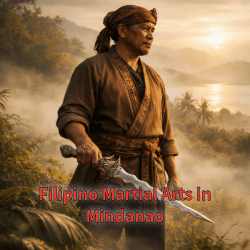
A seasoned Filipino martial artist holding a traditional kris blade at dawn, standing calmly in a misty southern Philippine landscape.

If Filipino Martial Arts feel complex anywhere, they feel alive in Mindanao.

That’s because Mindanao has never been a closed system. For centuries it has been a place of movement—of people, goods, ideas, and conflicts. Traders came through its ports. Warriors crossed its waters. Families intermarried across islands. Faith, language, and identity layered themselves over older traditions rather than replacing them outright.

What emerged was not a single martial art, but a living martial landscape—one where weapons, movement, ritual, and story all informed how people learned to fight and why they fought at all.

When people today ask about “Mindanao styles” of Filipino Martial Arts, the most honest answer is this: you’re not looking at one system. You’re looking at a region where martial knowledge grew inside culture, not outside it.

A Region Shaped by Water and Contact

Mindanao sits at the southern edge of the Philippine archipelago, closer to Borneo than to Luzon. That geography matters. Long before modern borders existed, Mindanao and the Sulu Archipelago were part of a wider Southeast Asian world tied together by sea routes.

These connections brought trade, yes—but also diplomacy, raiding, and defense. Over time, Islamic sultanates took root, particularly among what we now call Bangsamoro communities: the Maranao, Maguindanao, Tausug, Iranun, Sama-Bajau, and others. Alongside them lived numerous Lumad (non-Islamized Indigenous) groups, each with their own traditions and ways of organizing life.

Martial knowledge in this environment wasn’t abstract. It served real needs: protecting communities, enforcing authority, resolving disputes, and preparing young men—and sometimes women—for adult responsibility.

That practical foundation is one reason Mindanao martial traditions often feel different from modern, sport-oriented expressions of FMA. They weren’t built to be universal. They were built to be useful where they lived.

Blades That Tell You How People Fought

If you want to understand how Mindanao martial traditions move, start with the blades they favored.

The kampilan—a long, single-edged sword—is perhaps the most visually striking. It’s associated strongly with southern communities and with epic narratives preserved among the Maranao people. Long blades like this demand commitment. They shape how fighters judge distance, how they enter, and how they recover. You don’t fence lightly with a kampilan; you move with intent.

Alongside it, you find the kalis or kris, a double-edged blade whose southern Philippine forms reflect both function and identity. These weren’t just tools. They were heirlooms, status objects, and sometimes symbols of spiritual or social authority. Craftsmanship mattered. Lineage mattered. Carrying such a blade said something about who you were.

What’s important here is not just what these weapons were, but how they framed thinking. Many Mindanao traditions assume the fighter understands a complete kit: primary blade, secondary blade, shield, or off-hand control. That mindset shows up again and again, even when the weapon itself changes.

When Movement Becomes Memory: War Dance and Cultural Preservation

One of the most misunderstood aspects of Mindanao martial culture is the role of dance.

To outside eyes, performances like Sagayan can look purely ceremonial. But within Maguindanao, Maranao, and Iranun communities, Sagayan is tied to heroic narratives and preparation for conflict. Dancers carry sword and shield, move with deliberate posture, and embody ideals of courage, readiness, and leadership.

This isn’t “dance instead of combat.” It’s dance as archive.

In societies where knowledge was often transmitted orally—and where teaching certain skills openly could be dangerous—public performance preserved essential movement, timing, and intent without exposing everything. The epic Darangen, recognized internationally for its cultural importance, provides the narrative backbone for much of this symbolic world.

You see similar patterns among Tausug communities in the Sulu region. Pangalay, a refined and expressive dance tradition, carries body mechanics and spatial awareness that scholars have shown to be deeply contested and layered. Is it purely aesthetic? Is it martial? The answer is usually “both, depending on context.”

That ambiguity is not a flaw. It’s how culture protects itself.

Kuntaw and the Question of Names

Few terms cause more confusion in southern Filipino martial discussions than kuntaw.

The word itself comes from Chinese language roots and was used broadly across Southeast Asia to describe fist-based fighting methods within Chinese communities. In Mindanao, however, the term took on a distinctly local life.

Some families and groups used “kuntaw” to describe empty-hand methods integrated with local fighting logic. Others associated it with specific community practices or performance traditions. Over time, the word became less about origin and more about identity.

That’s why you’ll hear conflicting descriptions. And that’s okay.

Trying to force a single definition onto kuntaw in Mindanao misses the point. What matters is how people used the knowledge, who taught it, and how it fit into their lives.

Silat Influence Without Neat Borders

Mindanao also sits within the broader orbit of silat, a family of Southeast Asian martial traditions found across Indonesia, Malaysia, and surrounding regions. In southern Philippine contexts, silat influence tends to show up less as a formal label and more as a feel.

You see it in close-range entries, off-balancing, deceptive rhythms, and the blending of hard and soft responses. You see it in how fighters manage contact rather than just exchange strikes.

But again, this isn’t about importing a system wholesale. It’s about shared solutions to shared problems across a connected region.

Mindanao in the Modern FMA World

In the 20th century—especially after World War II—many Mindanao practitioners began interacting more openly with national and international Filipino Martial Arts communities. Arnis, eskrima, and kali frameworks provided a way to teach, preserve, and export material that had once been tightly guarded.

That process brought opportunity and risk.

On one hand, it kept traditions alive. On the other, it sometimes flattened regional distinctions or repackaged deeply cultural material as generic technique.

Understanding Mindanao’s martial heritage today means holding both truths at once: preservation and adaptation are happening simultaneously.

What to Take Away

If there’s one thing to remember, it’s this:

Mindanao’s martial traditions were never meant to be neat.

They grew out of real lives, real dangers, and real communities. Weapons mattered because they were used. Movement mattered because it carried meaning. Stories mattered because they taught people who they were supposed to become.

To study Filipino Martial Arts in Mindanao is not just to study fighting. It’s to study how a region remembered itself—through blades, bodies, and the spaces in between.

Arnis practitioner honoring Filipino martial arts heritage

Carry the Lineage Forward

From the villages of Luzon to the rhythm of the modern world, the art of Arnis endures—grace in motion, history in every strike. The Water Mountain Arnis Collection honors that lineage with apparel inspired by the forms, spirit, and brotherhood of Filipino martial arts. Wear what you train. Remember where it began.

Explore the Arnis Collection

Sources and Further Reading

  • UNESCO Intangible Cultural Heritage – Darangen: Epic Chant of the Maranao People

  • National Museum of the Philippines – Sagayan Festival documentation

  • Santamaria, M.C.M. (2016). Interrogating the Sanskritization of Pangalay

  • Jacinto, J. Pangalay Dance and Filipino Heritage Construction

  • Maruhom, S. Sagayan: The Dance of Meranao Royalty

  • Umpa, M.S. Martial Arts among the Bangsamoro Muslim

  • Wiley, Mark V. Filipino Martial Culture

  • Academic papers on Meranaw weapons, Moro blade traditions, and southern Philippine ethnogenesis

Filipino Martial Arts in Mindanao: Common Questions

Are Filipino Martial Arts from Mindanao different from other FMA styles?

Yes. Martial traditions in Mindanao developed within different historical, cultural, and social conditions than those in northern and central Philippines. Southern systems are often shaped by blade culture, maritime life, and local customs, rather than standardized training formats.

Is there one main Mindanao martial art?

No. Mindanao does not have a single unified martial art. Instead, it contains many localized traditions influenced by community needs, regional weapons, and cultural practices. What we call “Mindanao martial arts” is a regional category, not a single system.

What weapons are most associated with Mindanao martial traditions?

Southern Philippine traditions are strongly associated with bladed weapons such as the kris (kalis), kampilan, barong, and other regional blades. These weapons influenced how movement, distance, and timing were traditionally trained.

Why are war dances like Sagayan discussed alongside martial arts?

In Mindanao, war dances often preserve martial movement, posture, and cultural values in public form. These performances act as living records of martial identity, especially in societies where combat knowledge was traditionally passed down within families or communities.

Is silat practiced in Mindanao?

Elements commonly associated with silat appear in parts of southern Philippine martial culture, reflecting centuries of regional contact across Southeast Asia. Rather than formal systems, these influences often appear as shared movement principles and training approaches.

What does the term “kuntaw” mean in Mindanao martial traditions?

“Kuntaw” is a term used in parts of Mindanao to describe certain empty-hand and integrated fighting practices. Its meaning varies by community and lineage, and it is best understood as a locally adapted term rather than a single standardized style.

Are Mindanao martial arts still practiced today?

Yes. Some traditions continue through family lines, cultural performance, and modern Filipino Martial Arts schools. Others survive through adaptation, blending traditional principles with contemporary training methods.

Leave a Reply