What Was Removed: Spiritual, Secret, and Subtle
To make Qi Gong acceptable under Mao, the government stripped away many of its original parts.
Religious and Spiritual Language
Old texts talked about inner alchemy, energy channels, immortality, and divine forces. These were seen as superstition and were banned from official programs.
📚 Palmer (2007) notes that anything suggesting transcendence or metaphysical ideas was replaced with neutral, therapeutic terms.
Lineage and Secret Teachings
In traditional schools, Qi Gong was taught in secret from master to student. That didn’t work in a socialist society built on equality. Private lineages were shut down or forced to go public.
📚 Chen (2003) describes how traditional teachers had to “sanitize” their language or face political punishment.
Energy Healing and “Magic” Techniques
Practices like Fa Qi (Qi emission) and psychic-style sensing were labeled as dangerous or fraudulent. They didn’t fit the new scientific model and were considered cult-like.
📚 Palmer (2007) explains how public healing demonstrations drew suspicion and were eventually discouraged or banned.
Deep Meditation and Altered States
Advanced meditation that led to visions or trance states was treated as mental illness. These experiences didn’t fit the mechanical model and were even treated with psychiatric drugs in some cases.
📚 Chen (2003) writes about how hospitals sometimes diagnosed intense meditators as delusional or dissociative.
More Than Six Sounds: The Emotional Core Was Cut
One of the biggest losses was the emotional depth of traditional Qi Gong.
Yes, some people know about the Six Healing Sounds or Five Element emotions (like anger linked to the liver or grief to the lungs), but these are just one school among many. Across Daoist, Buddhist, and folk traditions, emotional work was core to internal development.
Movements were designed to transform emotions, not just relax you.
Sounds, breath, and intention helped clear energy blockages tied to trauma or imbalance.
Emotions were seen as energetic realities, not just moods.
But under Communist reform, that was too messy—too subjective. So emotions were reframed:
📚 Chen (2003) notes that emotional Qi Gong was reduced to vague ideas like “mood regulation” or “tension relief.”
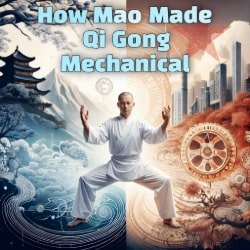
Turning Qi Gong Into a Machine
At the root of all these changes was a larger goal: to make China appear modern and scientific, both to its own people and the rest of the world.
Western science tends to see the body as a machine—with systems that can be mapped, measured, and fixed. So Mao’s China re-engineered Qi Gong to match that worldview.
Qi became something like oxygen or nerve energy.
The body was described using mechanical metaphors: pumps, wires, circuits.
Practice goals became medical: lower blood pressure, improve circulation, reduce fatigue.
This helped Qi Gong survive politically. It became a kind of “Chinese yoga” or physical therapy. But the holistic, poetic, and spiritual heart of Qi Gong was buried under a layer of gears and switches.
📚 Palmer (2007) calls this shift “a translation of ancient subtle practices into mechanical health routines.”