Flagstaff, AZ USA

Should You Practice Qi Gong in Hot Weather? | Summer Qi Gong Guide

Can you practice Qi Gong when it is hot outside? Yes—but Taoist and classical Chinese traditions suggest that good practice should adapt to the season rather than ignore it. Here is how to approach Qi Gong safely and intelligently during summer heat.
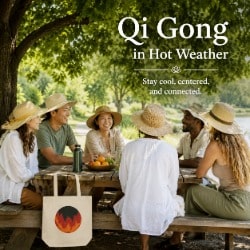
Men and women wearing wide-brim hats gather in the shade around a picnic table during hot-weather Qi Gong practice.

The temperature is 104 degrees.

The pavement is shimmering. The birds have retreated into the trees. The dog has reconsidered its commitment to outdoor recreation.

And somewhere, someone is standing in full sun performing a 45-minute Qi Gong set because that is what he does every afternoon.

There is much to admire in discipline.

There is somewhat less to admire in refusing to notice August.

This raises an interesting question for anyone who practices Qi Gong:

Should you practice Qi Gong when it is very hot?

The short answer is yes—but not necessarily in the same way you would practice on a cool spring morning.

And this is where Taoism enters the discussion.

You do not have to be a Taoist to practice Qi Gong. In fact, Qi Gong is not simply “Taoism turned into exercise.” But Taoist ideas have had a profound influence on Chinese cultivation practices, particularly the idea that good practice should respond to changing conditions rather than fight against them.

Summer provides an excellent example.

Can You Practice Qi Gong in Hot Weather?

Yes. Qi Gong can usually be practiced during warm weather, but the practice should be adjusted to the temperature, the type of Qi Gong being performed, and the individual practitioner.

On very hot days, that may mean practicing:

  • earlier in the morning or later in the day;
  • in shade or indoors;
  • for a shorter period;
  • with less physical intensity;
  • with appropriate hydration;
  • or not outdoors at all when dangerous heat conditions are present.

That is sensible modern heat safety.

Curiously enough, the underlying idea also fits very comfortably within traditional Chinese thinking.

To understand why, however, we should clear up a small historical problem first.

What Does Taoism Have to Do With Qi Gong?

Quite a lot.

But probably not in the way many people first assume.

The word Qi Gong, or qigong, is a relatively modern umbrella term. Many of the practices now grouped under that name existed much earlier under terms such as daoyin, involving guided movement and stretching, and yangsheng, usually translated as “nourishing life” or “cultivating life.”

Academic treatments of Qi Gong note that the modern term became widely used in the 20th century for practices that had previously appeared under older categories such as daoyin and yangsheng.

Those older practices developed in a Chinese cultural world shared by physicians, philosophers, religious practitioners, martial artists and others.

Taoists became important participants in that world.

The Stanford Encyclopedia of Philosophy, for example, describes yangsheng as a broad family of practices concerned with nourishing life and includes such things as breathing exercises and daoyin. It also notes that present-day practices called Qi Gong can reasonably be understood as descendants of this larger cultivation tradition.

So Qi Gong does not require someone to be Taoist.

But many forms of Qi Gong inherited ideas that are very comfortable within Taoism.

One of the most important is remarkably simple:

You are not separate from the conditions in which you live.

The season matters.

The weather matters.

Your age matters.

Your condition today matters.

Good practice responds accordingly.

That idea will sound familiar to anyone who has encountered Taoism, even casually.

A Very Short Introduction to the Taoist Idea

“Tao” is usually translated as the Way.

That translation can sound more mysterious than it needs to.

At its simplest, Taoist thought pays extraordinary attention to how things actually happen: patterns of change, cycles, relationships, timing, growth, decline, activity and rest.

The familiar yin-yang symbol represents part of this way of looking at the world.

Yin and yang are not simply “bad and good” or even “female and male.” They describe complementary tendencies.

Night and day.

Cooling and warming.

Rest and activity.

Inward and outward.

Neither side is supposed to win permanently.

Conditions change, and appropriate behavior changes with them.

That is important because a very common modern approach to exercise works somewhat differently.

Modern fitness culture often says:

Establish the routine. Follow the routine. Do not break the routine.

A Taoist-influenced cultivation model adds another question:

What are the conditions today?

That one question changes summer practice considerably.

The Classical Chinese View: Your Practice Should Change With the Season

One of the most important sources for traditional Chinese ideas about seasonal health is the Huangdi Neijing, or Yellow Emperor’s Inner Classic.

A distinction is useful here.

The Neijing is an ancient Chinese medical classic. It is not simply a Taoist scripture, and it is not a modern Qi Gong manual.

But it developed within the same broad intellectual environment that profoundly influenced later Taoist cultivation, Chinese medicine and practices concerned with nourishing life.

That makes it particularly useful here.

One of its best-known sections is Chapter 2 of the Suwen, commonly called the “Great Discourse on Regulating the Spirit According to the Four Seasons.”

The basic premise is exactly what the title suggests.

Human beings should not behave identically throughout the year.

Spring has one character.

Summer has another.

Autumn contracts.

Winter stores.

People should respond to those changes rather than behave as though the environment were irrelevant. The text describes the seasonal cycle as spring generating, summer growing, autumn gathering and winter storing. Other passages explicitly state that human beings correspond to these seasonal changes.

You do not have to accept every claim of ancient Chinese medicine to recognize the larger idea.

Conditions change. Intelligent behavior changes with them.

That is the classical foundation beneath our summer Qi Gong question.

Summer Is Yang. What Does That Mean?

If you have spent even a little time around Chinese medicine or Taoist practice, you may have heard that summer is yang.

For newcomers, that requires translation.

Yang broadly describes tendencies toward warmth, activity, expansion and outward movement.

Summer makes the idea fairly easy to understand.

Days are longer.

Temperatures rise.

Plants are fully active.

Animals are active.

People spend more time outside.

The natural world appears expanded rather than withdrawn.

Traditional Chinese thought therefore described summer as strongly yang.

This does not mean:

Summer contains lots of magical energy, so you should perform especially strenuous Qi Gong to collect as much of it as possible.

Unfortunately, one can find versions of that idea in modern wellness culture.

Traditional seasonal thinking is subtler.

You are not standing outside summer looking at it.

You are already inside the conditions of summer.

If the air is extremely hot, your body is already dealing with that environment before you begin your first movement.

This happens to produce an interesting point of agreement between traditional seasonal thinking and modern physiology, although the two explain it very differently.

Modern medicine tells us that physical activity produces heat and that environmental heat makes it more difficult for the body to dissipate that heat. The World Health Organization therefore advises people to avoid strenuous activity during the hottest periods of extreme heat and to use shade and cooler environments when necessary.

The ancient Chinese did not know modern thermoregulatory physiology.

They did know that summer was hot.

Sometimes very hot.

And they developed a health philosophy in which ignoring changing environmental conditions was generally considered a poor strategy.

Taoism Is Not About Defeating Nature

This is probably the most important Taoist point for someone encountering this material for the first time.

Taoism is often presented in the West as a philosophy of “going with the flow.”

That phrase is not entirely wrong, but it can make Taoism sound like a philosophy for people who cannot be bothered to make plans.

A better word might be responsiveness.

The skilled person observes what is happening and responds with the appropriate amount of effort.

Not too much.

Not too little.

Not necessarily the same amount yesterday required.

This is related to the famous Taoist principle wu wei, commonly translated as “non-action.”

It does not normally mean doing absolutely nothing.

It is closer to acting without unnecessary forcing.

So imagine two Qi Gong practitioners.

One notices that the temperature has risen dramatically. She moves her practice to early morning, shortens the vigorous section and performs the remainder in shade.

The other performs exactly the same routine at exactly the same time and intensity because changing it would demonstrate insufficient discipline.

Which one is being more consistent?

The second.

Which one is behaving more like a Taoist?

That question is considerably more interesting.

Doesn’t the Neijing Say Not to Avoid the Sun?

Here the ancient text provides us with a delightful complication.

The summer passage of the Neijing includes the phrase:

無厭於日 — wú yàn yú rì

It is often translated along the lines of “do not be averse to the sun.”

One could imagine what modern social media would do with this.

ANCIENT CHINESE SECRET: WHY YOU NEED MORE SUN

Add a photograph of a shirtless man on a mountain and we are nearly finished.

But that is not responsible interpretation.

The phrase occurs within a larger discussion of participating appropriately in summer’s expansive character. It is not a modern medical instruction to perform strenuous exercise at 3:00 p.m. during an excessive heat warning.

This gives us a useful rule for reading traditional Chinese health texts:

A classical teaching can help us understand the tradition without automatically becoming modern medical advice.

That distinction becomes especially important whenever Taoism, Chinese medicine and health overlap.

How Should You Change Qi Gong Practice in Hot Weather?

For most healthy practitioners, the adjustments do not have to be complicated.

Practice During the Cooler Part of the Day

Early morning is an obvious choice during summer.

This happens to overlap nicely with long-standing Chinese preferences for morning cultivation, but no elaborate theory is necessary to explain one major advantage.

It is cooler.

Current World Health Organization guidance similarly recommends avoiding strenuous activity during the hottest part of the day during periods of extreme heat.

You do not receive additional cultivation points for waiting until the patio can fry an egg.

Reduce the Intensity When Necessary

Summer practice does not have to become lazy practice.

It can become appropriate practice.

Depending on your system, that might mean:

  • using more relaxed postures;
  • reducing muscular tension;
  • performing fewer repetitions;
  • practicing more slowly;
  • emphasizing gentler walking or standing work;
  • shortening vigorous conditioning.

Specialized Qi Gong methods should still be practiced according to the instructions of a qualified teacher.

Seasonal adjustment does not mean randomly redesigning a system you do not yet understand.

Shorten the Practice When Conditions Require It

Twenty comfortable minutes can be preferable to forty miserable ones.

That should not be controversial.

And yet people regularly treat the length of a practice session as though the final ten minutes somehow activate the warranty.

They do not.

If conditions change, session length can change.

Use Shade or Practice Indoors

There is nothing spiritually inferior about shade.

There is also nothing spiritually inferior about air conditioning.

A comfortable summer morning under a tree can be a wonderful place to practice.

During dangerous heat, indoors may be the wiser choice.

The Tao survived the invention of HVAC.

Stay Appropriately Hydrated

Hot conditions and physical activity increase the body’s need to regulate temperature.

For ordinary practitioners, that means avoiding unnecessary dehydration and having access to fluids.

Individual medical needs can differ. Someone who has been given specific instructions about fluid intake because of a medical condition should follow professional medical guidance rather than a generalized Qi Gong article.

That last point is important.

Traditional cultivation and modern healthcare do not need to compete.

Sweating Is Not Proof That Your Qi Gong Is Working Better

Summer provides fertile ground for another wellness misconception.

Sweat.

People sometimes associate heavy sweating with “detoxification,” purification or proof that a practice is energetically powerful.

The human body certainly eliminates small amounts of some substances through sweat.

But the primary reason we sweat during heat and exertion is much less mysterious:

Cooling.

Heavy sweating is therefore not a useful measure of spiritual progress.

More importantly, ordinary symptoms of overheating should not be reinterpreted as evidence of energetic transformation.

Heat illness can involve weakness, headache, dizziness, nausea, thirst and other symptoms. Severe heat illness can produce confusion, loss of consciousness or seizures and may constitute a medical emergency. WHO’s current heat-health guidance specifically identifies heat exhaustion and heatstroke as important risks of extreme heat.

This leads to an excellent rule for anyone practicing Qi Gong:

Do not turn a potential medical symptom into an energetic explanation.

If you become dizzy while doing Qi Gong in extreme heat, the first conclusion should not be:

My qi must be moving very powerfully today.

Stop.

Get somewhere cooler.

Assess what is happening.

Serious symptoms require appropriate medical attention.

That isn’t a rejection of Qi Gong.

It is common sense.

Taoism has traditionally been rather fond of that.

Is Summer Associated With the Heart in Chinese Medicine?

Yes, traditionally.

Chinese medical and Five Phase theory commonly associates summer with the Fire phase and with the traditional Heart, or xin, system.

Those correspondences appear within the classical Chinese medical tradition and are useful when studying how traditional systems organized the body, environment and seasons. The Neijing contains numerous seasonal correspondences of this type.

But we need another important distinction.

The traditional Chinese medical “Heart” does not correspond perfectly to the anatomical heart as understood by modern cardiology.

Therefore:

“This Qi Gong is traditionally associated with Heart qi”

is a statement about traditional Chinese practice.

“This Qi Gong treats heart disease”

is a medical claim requiring appropriate clinical evidence.

Those are not interchangeable statements.

Anyone teaching traditional practice responsibly should be comfortable saying so.

Is Outdoor Summer Qi Gong Good for Beginners?

It certainly can be.

A comfortable summer morning is an excellent setting for gentle movement.

Practicing outdoors can also teach something important that goes beyond exercise.

You begin to notice:

temperature,

wind,

humidity,

light,

sound,

ground conditions,

your breathing,

and your own response to all of them.

This is one of the places where Taoist influence on cultivation becomes easier to understand.

The practitioner is not attempting to withdraw completely from the environment.

The environment becomes part of what is being noticed.

A beginner, however, may not yet know how much effort a movement requires.

People often make gentle exercises strenuous by trying extraordinarily hard to relax correctly.

For this reason, beginners should be particularly suspicious of the idea that discomfort automatically indicates progress.

Sometimes discomfort indicates progress.

Sometimes it indicates poor technique.

And sometimes it indicates that you are standing in the Arizona sun in August.

Wisdom consists partly in learning the difference.

What Is the Best Qi Gong for Hot Weather?

There is no single Qi Gong form that is best for every practitioner.

Different traditions have different methods and objectives.

But the quality of sensible hot-weather practice is easier to describe:

relaxed rather than forced;
responsive rather than rigid;
comfortable rather than punishing.

For many people, that may mean gentle moving forms, relaxed standing, walking practices or quieter seated work.

Vigorous Qi Gong can still have its place when environmental conditions are appropriate and the practitioner is accustomed to it.

Summer does not prohibit effort.

It changes the calculation.

The Bigger Taoist Lesson

And now we arrive at the part of the discussion that interests me more than the weather.

Many people begin Qi Gong because they want to become more sensitive.

They want to notice their breathing.

Their posture.

Their tension.

Their attention.

Perhaps their qi.

They want to stop moving through life mechanically.

Then someone gives them a practice schedule.

Six months later:

Same time.

Same movements.

Same duration.

Same intensity.

Same repetitions.

Rain or shine.

Tired or rested.

January or August.

We have somehow used a practice intended to make the person more responsive to create another thing they do automatically.

The irony is magnificent.

The Taoist contribution to Qi Gong offers a useful correction.

Pay attention first.

Conditions change.

So intelligent action changes.

Summer is not winter with brighter scenery.

Age 70 is not age 25 with more birthdays.

A day of exhaustion is not a day of abundant energy with poorer motivation.

A heat wave is not a normal Tuesday that happens to require more discipline.

Taoism asks us to become sensitive enough to recognize differences—and skillful enough to respond to them.

That does not mean abandoning consistency.

It means becoming consistent about something deeper than repetition.

So, Should You Practice Qi Gong in Hot Weather?

Yes.

But the more interesting question is:

How should today’s conditions change your practice?

Practice earlier when the morning is cooler.

Use shade.

Move indoors when the heat becomes excessive.

Practice gently when gentleness is appropriate.

Shorten the session when conditions call for it.

Stay appropriately hydrated.

And do not reinterpret dizziness, nausea or confusion as evidence that your qi has suddenly become spectacular.

You do not need to become a Taoist to practice Qi Gong.

But one of Taoism’s contributions to the practice is worth borrowing:

Notice what is actually happening.

The old Chinese cultivation traditions were not built around conquering the season.

They were built around learning how to live intelligently within change.

Summer changes.

You change.

Practice changes.

If our Qi Gong teaches us to notice everything except that, we may be performing the movements very well.

Whether we have understood the lesson is another question.

Health and Safety Note

Qi Gong is generally practiced as a low-impact activity, but physical activity in hot environments can contribute to heat-related illness. This article provides general educational information about Qi Gong, Taoist tradition and hot-weather practice; it is not individualized medical advice. People with medical conditions, a history of heat illness, pregnancy, or medications that may affect heat tolerance should seek appropriate professional guidance when necessary. Severe heat-related symptoms can constitute a medical emergency.

Sources and Further Reading

  • Huangdi Neijing Suwen, “Great Discourse on Regulating the Spirit According to the Four Seasons.”
  • Stanford Encyclopedia of Philosophy, “Religious Daoism,” section on yangsheng and cultivation practices.
  • Scholar discussion of Qi Gong as a modern term applied to older yangsheng and daoyin practices.
  • World Health Organization, “Heat and Health,” updated July 31, 2026.
  • World Health Organization, “Keep Cool in the Heat,” June 2026.

Frequently Asked Questions About Qi Gong in Hot Weather

Can you practice Qi Gong in hot weather?

Yes. Qi Gong can generally be practiced in warm weather, but the session should be adapted to the conditions. On very hot days, consider practicing during cooler hours, using shade or an indoor space, shortening the session, and reducing the intensity.

What is the best time to practice Qi Gong in summer?

Early morning is often a good choice because temperatures are usually lower. Evening may also be suitable once temperatures begin to fall. During periods of extreme heat, strenuous outdoor activity should generally be avoided during the hottest part of the day.

Should summer Qi Gong be different from winter Qi Gong?

It can be. Traditional Chinese cultivation places considerable emphasis on adjusting activity to seasonal conditions. Summer is traditionally associated with warmth, expansion, and outward activity, while winter is associated more with conservation and storage. This does not require completely different exercises, but it supports adjusting the intensity, duration, and character of practice.

Is Qi Gong a Taoist practice?

Qi Gong is broader than Taoism. Practices now grouped under the term Qi Gong developed from older Chinese traditions of movement, breathing, meditation, martial training, and life cultivation. Taoist traditions contributed substantially to this history, particularly through practices concerned with yangsheng, or nourishing life, but medical, Buddhist, martial, and other Chinese traditions also influenced Qi Gong.

Why does Taoism matter when discussing summer Qi Gong?

Taoist thought emphasizes responsiveness to changing conditions rather than forcing one fixed approach onto every situation. This fits naturally with seasonal Qi Gong practice. Instead of performing exactly the same routine regardless of temperature or season, the practitioner observes the environment and adjusts appropriately.

Does the Huangdi Neijing recommend seasonal practice?

The Huangdi Neijing, or Yellow Emperor’s Inner Classic, teaches that human behavior should correspond to the changing seasons. It discusses different patterns of activity for spring, summer, autumn, and winter. The text is an ancient Chinese medical classic rather than a modern Qi Gong manual, but its seasonal approach strongly influenced later Chinese health and cultivation traditions.

Is summer associated with the Heart in traditional Chinese medicine?

Yes. Traditional Chinese medical theory commonly associates summer with the Fire phase and the traditional Heart, or xin, system. This is a traditional theoretical correspondence and should not be interpreted as evidence that summer Qi Gong prevents or treats cardiovascular disease.

Should Qi Gong make you sweat in hot weather?

Qi Gong may cause sweating, especially during vigorous practice or warm weather, but sweating is not a measure of how effective the practice is. Heavy sweating should not be interpreted as proof of detoxification or stronger qi.

Is dizziness during Qi Gong normal?

Dizziness should not automatically be interpreted as an energetic effect, particularly when practicing in hot weather. Stop the activity, move to a cooler environment, and assess how you feel. Persistent or severe symptoms require appropriate medical attention. Confusion, collapse, seizures, or other signs of severe heat illness require urgent medical care.

Is it better to practice Qi Gong indoors during a heat wave?

Often, yes. When outdoor temperatures are dangerously high, a cooler indoor environment may be a safer and more comfortable place to practice. Moving indoors does not diminish the value of the practice. Adapting to conditions is consistent with the traditional principle of responding intelligently to the environment.

What type of Qi Gong is best during very hot weather?

There is no single best form for everyone. In very hot conditions, gentler moving forms, relaxed standing, walking practices, or quiet seated work may be more appropriate than strenuous martial or strongly contracting exercises. The correct choice depends on the individual, the system being practiced, and the environmental conditions.

Who should be especially careful about practicing Qi Gong in extreme heat?

People who are older, pregnant, taking medications that affect heat tolerance or hydration, or living with certain medical conditions may be more vulnerable to extreme heat. Anyone with concerns about exercise or heat exposure should follow individualized advice from an appropriate healthcare professional.

Leave a Reply